
In the West, Ambrose triumphs over Valentinian thanks to a fortuitous discovery. In the East, John Chrysostom comes on the scene at a time of crisis for the city of Antioch.
Links:
Photo of the Brescia Casket.
Ambrose’s letter on the finding of the bones of SS. Gervasius and Protasius
The crypt of Ambrose with the relics of SS. Gervasius and Protasius
Wikipedia entry and pictures of the Brescia Casket
John Chrysostom’s Homilies on the Statues
Justin Stephens: A Pagan and Christian interpretation of the Riot of the Statues
Caroly Joslin Watson. “The Program of the Brescia Casket”. Gesta. Vol. 20. No. 2 (1981: 283-298.
Check out the other great Catholic podcasts at the Starquest Production Network
To listen, just click on the link below:
#385 – A History of the Catholic Church – The Riot of the Statues

Ambrose and Valentinian II fight over the right of the Homoean Arians to use the churches of Milan while the threat of Magnus Maximus continues to grow.
Links:
Statue of Valentinian II.
Ambrose’s Sermo contra Auxentium – considered a masterpiece of ancient political rhetoric
Ambrose’ letter to Valentinian rejecting the proposed debate
Check out the other great Catholic podcasts at the Starquest Production Network
To listen, just click on the link below:
#384 – A History of the Catholic Church – The Crisis of the Churches
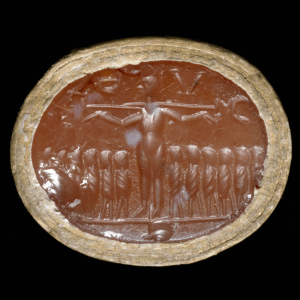
Priscillian’s triumphant return to Hispania does not last long. He faces renewed charges of heresy and sorcery and his fate is placed in the hands of the new emperor Magnus Maximus.
Links:
Photo of gem engraved with image of the Crucifixion courtesy of the British Museum.
Pope Leo I’s letter on the errors of the Priscillians
Augustine on Priscillians
Acts of the Council of Toledo [in Spanish]
Virginia Burrus, The Making of a Heretic: Gender, Authority, and the Priscillianist Controversy
Check out the other great Catholic podcasts at the Starquest Production Network
To listen, just click on the link below:
#383 – A History of the Catholic Church – The Problem of Priscillian – Part II

We start calling the bishops of Rome – the popes of Rome. Priscillian of Avila offers us an example of the challenges of the rising ascetical movement as bishop fights against bishop in Spain.
Links:
Photo of Gold-glass depiction of Jonah and the whale by Anne-Marie Bouché
More on Priscillian.
Various New Testament Apocrypha, including those that Priscillian would have used.
About the so-called Epistle of Saint Paul to the Laodiceans
Map of the Roman provinces in Hispania at the time of Priscillian. Priscillian and his main support was found in Spanish Galicia/Gallaecia.
Check out the other great Catholic podcasts at the Starquest Production Network
To listen, just click on the link below:
#382 – A History of the Catholic Church – The Problem of Priscillian – Part I

Major political and religious events take place in the Empire as Gratian moves against some of the oldest Roman pagan traditions, Magnus Maximus moves against Gratian, and Ambrose asserts himself against Valentinian.
Links:
Solidus of Gratian by Rasiel Suarez
More on the Altar of Victory, including pictures of what it may have looked like.
The Relatio of Symmachus and the two responses of Ambrose
Cameron, Alan “Gratian’s Repudiation of the Pontifical Robe”. The Journal of Roman Studies. Vol. 58. Parts 1 and 2 (1968). pp. 96-102.
Cameron, Alan. “The Imperial Pontifex”. Harvard Studies in Classical Philology. 103 (2007). 341-84.
Thomas Graumann. “The Synod of Constantinople, AD 383. History and Historiography”. Millenium Jahrbuch. 7 (2010). 133-168.
Check out the other great Catholic podcasts at the Starquest Production Network
To listen, just click on the link below:
#381 – A History of the Catholic Church – The Altar of Victory

The debates over the comparative worth of marriage and virginity in Rome, not suprisingly, also lead to debates over the Christian understanding of Mary as a model of the faith and the early steps toward the doctrine of Mary’s perpetual virginity.
Links:
Gold-glass image of Mary with Saints Peter and Paul by Rama
The Protoevangelium of James
Jerome’s The Perpetual Virginity of Mary Against Helvidius
Hunter, David G. (Spring 1993). “Helvidius, Jovinian, and the Virginity of Mary in Late Fourth-Century Rome”. Journal of Early Christian Studies. Johns Hopkins University Press. Vol. 1 (number 1): pp. 47–71
Check out the other great Catholic podcasts at the Starquest Production Network
To listen, just click on the link below:
#380 – A History of the Catholic Church – Virgin and Mother

Saint Jerome takes advantage of his time in Rome to promote the consecrated life, especially among Rome’s upper class. These women: Marcella, Paula, Lea, Eustochium and Blaesilla – will, in turn, play a major role in the history of the Church. However, Jerome will also find himself caught in the ecclesiastical politics of Rome, much to his detriment.
Links:
Painting of Saint Jerome with Saints Paula and Eustochium by Francisco de Zurbarán
Jerome’s letter on Marcella
Jerome’s letter on Paula the Elder
Jerome’s letter to Eustochium on virginity
Jerome’s letter to Laeta about her daughter Paula
Check out the other great Catholic podcasts at the Starquest Production Network
To listen, just click on the link below:
#379 – A History of the Catholic Church – The Holy Women of Rome
February 24, 2017 – 8:20 pm

The rise of virginity in the West runs up against traditional Roman support for marriage and children. Saint Ambrose, however, strives to change the minds of the Western Christians and makes an important connection between virginity and our understanding of the Church.
Links:
Saint Ambrose and his sister, Saint Marcellina by Giovanni Dall’Orto
Ambrose’s Concerning Virginity
Nathalie Henry, “The Song of Songs and the Liturgy from the Velatio in the Fourth Century: From Literary Metaphor to Liturgical Reality”, Continuity and Change in Christian Worship: Papers Read at the 1997 Summer Meeting and the 1998 Winter Meeting of the Ecclesiastical History Society, ed. R. N. Swanson, Rochester: The Boydell Press, 1999, pp. 18-28.
Check out the other great Catholic podcasts at the Starquest Production Network
To listen, just click on the link below:
#378 – A History of the Catholic Church – The Velatio
February 17, 2017 – 8:00 pm

The rise of the ascetical movement brought with it the rise of the debate over the relative virtue of marriage versus celibacy. This debate became even more intense as the number of ascetics rapidly expanded in the fourth century and Virgins move to occupy an important position in the life of the Church.
Links:
Saint Piamun and her mother in an Egyptian village by Charles-Antoine Coypel
Tertullian On Exhortation to Chastity
Cyprian of Carthage On the Dress of Virgins
Gregory of Nyssa On Virginity
Check out the other great Catholic podcasts at the Starquest Production Network
To listen, just click on the link below:
#377 – A History of the Catholic Church – Brides of Christ
February 10, 2017 – 8:00 pm

This week we begin a series of episodes on marriage and virginity. While the Christian understanding of marriage is rooted in the Old Testament and Jewish tradition, it is also influenced by the encounter with Greek and Roman Culture as it strives to promote the importance of unity between husband and wife and the the procreation of children. Moreover, the goodness of marriage in the Christian tradition is connected with the belief in the goodness of everything God created.
Links:
Gold-Glass “Medalion” of a Christian couple being crowned by Jesus. The Latin reads “Sweetheart, may you live [long]”
Jewish Seven Blessings
Tertullian’s Ad Uxorem
Gregory Nazianzen on the marriage ritual in the Eastern half of the Roman Empire
Paulinus of Nola’s Ode on Marriage can be found in Documents of the Marriage Liturgy, Collegeville: The Liturgical Press, 1992, pp. 30-39.
Check out the other great Catholic podcasts at the Starquest Production Network
To listen, just click on the link below:
#376 – A History of the Catholic Church – Be Fruitful and Multiply


 catholicunderthehood.com


.svg)


