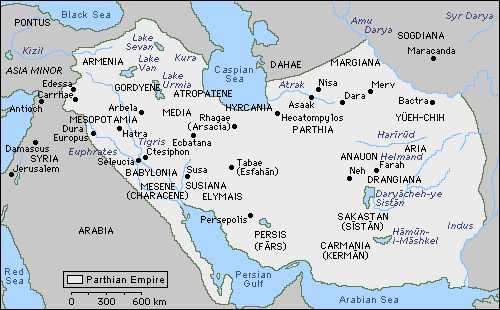
Having looked at several different heresies and the responses of the Church authorities to that – emphasis on the monepiscopacy, apostolic tradition and the development of the New Testament Canon. In this episode, we reflect on the growth and continuing importance of the authority of the bishop of Rome. We also look at the struggle about inculturalization – how much should the Church adapt to the Hellenistic culture?
We will also look at the Church of the East and see how it dealt with many of these same issues.
Links:
Image – Christ Handing the Keys to St. Peter by Pietro Perugino
Concluding our series on early Christian heresies with Marcionism, a movement that became so popular that some estimates are that half of the Christians in the Eastern half of the Roman Empire will be supporters of Marcion of Sinope and his views on Old Testament.
Indeed, Marcion’s condemnation of the Old Testament and the strength of Marcion will be one of the key reasons for the Christian Church to begin the process of defining the faith in what will become the New Testament.
Continuing an examination of the diverse beliefs present among the Christian Church in the second century, this episode takes a look at the Gnostics – in particular the Valentinians.
Valentinius, a teacher of great influence who nearly became the Bishop of Rome, founded a system of belief that spanned the Roman Empire founded on the principle that the world in which we live is a false reality and only the teachings of Jesus can help us to see the truth.
As the Christian Church grew both in numbers and in its geographical scope, so did differences among believers also increase. Some of these differences will be minor, others will be significant enough that they will cause splits among the faithful.
The Montantists, or the New Prophecy, emphasized the importance of the Holy Spirit in the lives of the faithful but their strict morality, their charismatic practices, and the role of women in their movement will cause conflict with magisterial leadership and end in accusations of heresy against them.
Using the account of the martyrdom of Saint Polycarp, we look at how the theology of Christian martyrdom develops. What were the reasons why some Christians sought martyrdom? What type of opposition to martyrdom existed?
As the Christians spread throughout the Roman Empire, so did opposition against them increase as well – hostility from neighbors and persecution from State. In this episode, we look at the reasons why Tacitus called Christianity “a most mischievous superstition” and the ways that anti-Christian hostility manifested itself.
Links:
Image of Emperor Marcus Aurelius offering a sacrifice
The spread of the teachings of Jesus brings with it also increasing differences about who are the true followers of His Word. Those followers of Jesus who have come to be called Christians and members of the Catholic Church, begin to set standards for who belongs to the faith – and who is outside it.

 #304 – A History of the Catholic Church – Having Preeminent Authority




 catholicunderthehood.com