On 6 April 1850, the Society of Jesus began to publish its very influential journal La Civiltà Cattolica or The Catholic Civilization in Naples, Italy but would later move to Rome.
Founded by Fr. Carlo Maria Curci, SJ. at the request of Pope Pius IX and with the purpose of defending Catholicism in modern society, the journal was initially directed against the attacks of liberalism and freemasonry.
In the second half of the 19th century, the journal will defend papal documents such as the Syllabus of Errors and the teachings of the First Vatican Council. It will also encourage the teaching of the philosophy of St. Thomas Aquinas.
In the early to mid 20th century, La Civiltà Cattolica will focus on defending the Catholic Church against the threats of communism and support the growth of Catholic political parties in Italy. After Vatican II, the journal will move from a more confrontational attitude to one seeking more cooperation with contemporary society in line with the views of Pope John XXIII and the post-Vatican II papacy.
It continues to be seen as the unofficial voice of the Vatican as its articles are supposed to receive approval by the Vatican Secretary of State before publication.
For more on La Civiltà Cattolica.

The Cadaver Synod or the Synod Horrenda was one of the most unpleasant events in the history of the papacy at which Pope Stephen VI placed his predecessor Pope Formosus on trial. What made it more unpleasant was that Pope Formosus had died nine months earlier.
Links:
For more on the Cadaver Synod
Robert Browning’s The Ring and The Book account of the Cadaver Synod
On the difference between valid and licit sacraments
Picture is Jean Paul Laurens’ “Le Pape Formose et Etienne VII”
Be sure to check out the CUTH blog for more on the history of the Catholic Church
Send e-mail questions and comments to catholicunderthehood@gmail.com or leave voice mail at 1 740 936 4354
To listen, just click on the link below:
 #227 – The Cadaver Synod
In a war with Venice and their Doge Pietro Gradeningo over political control of Ferrara in Italy, Pope Clement V issued an excommunication of the entire city of Venice on 27 March 1309 – an ecclesiastical penalty that would not be lifted until 17 February 1313.
Clement decreed not only that the Venetians were to be considered outside of the Church but also annulled trade agreements and religious services. When the excommunication failed to convince Venice to accept Papal control of Ferrara, a crusade against Venice would be ordered a few months later.
At this time, ecclesiastical penalties such as excommunication or interdict, the prohibition on the celebration of sacraments in a particular area, were seen as effective means of encouraging a population to persuade its leaders to change their ways and accept papal demands.
Due to the problems caused by the animosity of the papacy and the threats of other Italian city states who wished to take advantage of the pope’s crusade, the citizens of Venice rebelled against their Doge/leader. However, attempts to overthrow the Venetian government failed and contributed to the establishment of the Council of Ten as an emergency, but eventually permanent, government for the city state.
The death of the Doge and willingness of the new Venetian leadership to accept Papal control over Ferrara brought about the lifting of the excommunication. Indeed, when Doge Pietro Gradeningo died religious burials were prohibited by the excommunication and he would be laid in an unmarked grave.
For more information
Today is Purple Day. The inspiration of Cassidy Megan, this day calls for the wearing of purple so as to raise awareness of epilepsy.
While there are several saints that are connected with the curing of leprosy, it’s not easy to find a Catholic saint who suffered from epilepsy – though some have speculated that Saint Joan of Arc may have had epilepsy. Certainly the stigmatization of epilepsy and past tendencies to see the epileptic as “possessed” have contributed to this. Indeed, until the most recent Code of Canon Law in 1983, an epileptic could not be ordained to the priesthood.
Bl. Pius IX, Giovanni Maria Mastai Ferretti, too faced this prejudice. He applied to enter the Papal Noble Guard in 1815, but after experiencing an epileptic seizure he was forced to leave. However Pope Pius VII supported his vocation, though for awhile it was required that another priest assist Giovanni during the liturgy. Giovanni would later take the name Pius in honor of Pius VII.
While Pius IX would later assert that Our Lady of Loretto had cured him of his epilepsy there are signs that he continued to struggle with seizures – albeit less often – and that, perhaps, it was an epileptic seizure that contributed to his death. There is also some indication that Pius IX’s belief that the Mother of God had healed him was part of his motivation to proclaim the doctrine of the Immaculate Conception in 1854.
After his death, the issue of epilepsy continued to color interpretations of Pius IX and his actions.
There is a very interesting paper on this subject by Joseph I. Sirven, MD, Joseph F. Drazkowski, MD and Katherine H. Noe, MD, PhD entitled Seizures Among Public Figures: Lessons Learned From The Epilepsy of Pope Pius IX which was published by the Mayo Clinic in 2007. If these authors are correct in their assertions perhaps Bl. Pius IX should be the patron saint of Purple Day.
On this day in 1966, Pope Paul VI met with Archbishop of Canterbury Michael Ramsey in the Sistine Chapel. This was the first meeting between the heads of the Catholic and Anglican churches in 400 years.
Paul VI and Archbishop Ramsey would sign a common declaration stressing their desire to work together on issues of mutual importance such as dealing with issues involving mixed marriages of Anglicans and Catholics. This dialogue would be “founded on the Gospels and on the ancient common traditions”.
Paul VI also presented the archbishop with the episcopal ring he had wore as Archbishop of Milan. This ring is still worn by the Archbishops of Canterbury when they visit the Pontiff.
This meeting would also lead to the establishment of the Anglican Center in Rome.
Time Magazine’s article on this meeting can be found here.
A photo of the meeting where the Holy Father presented the Archbishop with a 13th century fresco of Christ can be found here.
March 21, 2010 – 10:56 am

Maria Gaetana Agnesi was one of the brightest mathematicians of the 18th century who just as she had been given a position at the Bologna Academy of Sciences gave it all up to serve the poor. Also in this episode a few words on Kyriopascha and Palmbuschen.
Links:
Massimo Mazzotti has written a recent book on Maria Agnesi called “The World of Maria Gaetana Agnesi, Mathematician of God”
Here’s a good website with information about Maria Agnesi
Here’s a good website explaining “The Witch of Agnesi”
You can participate in the podcast listener’s survey here.
Send e-mail questions and comments to catholicunderthehood@gmail.com or leave voice mail at 1 740 936 4354
To listen, just click on the link below:
#226 – Where Peace Reigns
March 20, 2010 – 12:17 pm
The Abbey of Santa Maria di Grottaferata was originally founded in 1024 by John XIX, so it predates the schism. Most of the original structures are gone.
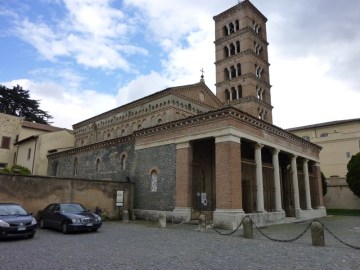
As you can see, the inside of the church is very Romanesque –

But there is a nice Iconostasis – note the presence of the choir stalls

A closer look at the Icon of the Blessed Mother – Byzantine and Baroque/Rococo:

This is the baptismal font:

One of the original mosaics:

The millennial icon of the Blessed Mother for the monastery:

You can find out more about the monastery at its web site.
January 17, 2010 – 4:47 pm

While Chess did not originate in Catholic culture, the culture of Catholicism certainly influenced the game and in turn Chess influenced the way Catholics understood their faith.
Links:
Chapter 16 of the “The Way of Perfection” by St. Theresa of Avila
Gautier de Coinci on the Virgin Mary as the Queen of Chess
Treatise on the Game of Chess by Fr. Pietro Carrera
Paolo Boi and the Devil
Play a game of Carrera Chess
Jewish Story – “The Pope’s Game of Chess”
For more see “Birth of the Chess Queen: A History” by Marilyn Yalom
The Immortal Game: A History of Chess by David Shenk
Help support the SQPN giving campaign!
Send e-mail questions and comments to catholicunderthehood@gmail.com or leave voice mail at 1 740 936 4354
To listen, just click on the link below:
#221 – Chess Club
December 6, 2009 – 1:46 pm

Faced with the twin threats of WWII and the Holocaust,the people of Assisi looked to their three protectors – God, Saint Francis, and German Colonel Valentin Müller. Plus, Austrian Alpine Horns.
Links:
“The Strategy That Saved Assisi” by Francesco Santucci
“Three Heroes of Assisi in World War II: Bishop Guiseppe Nicolini, Colonel Valentin Müller, Don Aldo Brunacci” edited and written by Josef Raischl SFO and André Cirino OFM
Cria-BD – Christian Comic Book blog and web site
Help support the SQPN giving campaign!
Send e-mail questions and comments to catholicunderthehood@gmail.com or leave voice mail at 1 740 936 4354
To listen, just click on the link below:
#215 – The Saving of Assisi
December 2, 2009 – 3:13 pm
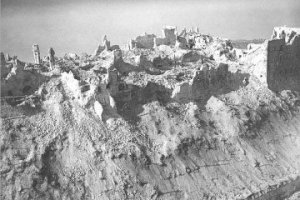
In WWII, the Allied forces seeking to reach Rome had to get past the German held Gustav line, unfortunately for the Benedictine Abbey of Monte Cassino – it was at ground zero.
Links:
The History Network Podcast on the Battle of Monte Cassino – contains more information about the battles around Monte Cassino itself.
History of the Battle of Monte Cassino
BBC site on the Battle of Monte Cassino
John Paul II’s words on the fate of Monte Cassino
Wojtek the Soldier Bear
Help support the SQPN giving campaign!
Send e-mail questions and comments to catholicunderthehood@gmail.com or leave voice mail at 1 740 936 4354
To listen, just click on the link below:
#214 – The Fall of Monte Cassino


 catholicunderthehood.com