
Books were the livelihood of the medieval monk but they were rare and expensive. Not surprisingly this meant various and create ways to protect them.
Links:
The Evolution of the Medieval Book
The Art of the Book in the Middle Ages
Medieval Books of Hours
“Anathema! Medieval Scribes and the History of Book Curses” by Marc Drogin
Check out the other great podcasts at the Starquest Production Network
Send e-mail questions and comments to catholicunderthehood@gmail.com
To listen, just click on the link below:
 #251 – Medieval Books

The increasing threat to the Papal States by the Kingdom of Italy will lead to new calls for Catholics to come to the aid of Pius IX. Catholic in Canada respond eagerly. Catholics in the United States are much more hesitant.
Links:
Canadian and American Zouaves in the Papal Army, 1868-1870 by Howard R. Marraro, PhD
Last Crusade by Dr. John C. Rao
The Pope’s Legion: The Multinational Fighting Force that Defended the Vatican by Charles A. Coulombe
Image of Canadian Zouaves leaving for the Papal States.
Portiuncula Indulgence – August 2nd!
CNMC – Catholic New Media Celebration
Check out the other great podcasts at the Starquest Production Network
Send e-mail questions and comments to catholicunderthehood@gmail.com
To listen, just click on the link below:
#250 – Papal Zouaves, Part II
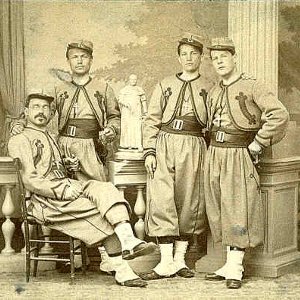
In 1860, faced with threats of Italian nationalism, the Pope appealed for help. Thousands of Catholics traveled to Rome to protect Pius IX and to give their lives for their faith.
Links:
The Vatican Rifles
The Pope’s Legion: The Multinational Fighting Force that Defended the Vatican by Charles A. Coulombe
Check out the other great podcasts at the Starquest Production Network
Send e-mail questions and comments to catholicunderthehood@gmail.com
To listen, just click on the link below:
#249 – Papal Zouaves, Part I

The tradition and devotion of the Retablos show the common desire of Catholics to have physical and visual expressions of their faith. They also show how different cultures adopt these devotionals to express their own particular culture.
Links:
Example of Mexican and New Mexican Retablos
Examples of Peruvian Retablos
Example of a Spanish Retablos
Image of Peruvian Retablo by Patty Mooney
Be sure to check out the CUTH blog for more on the history of the Catholic Church
Facebook
Twitter
Also check out the other great podcasts at the Starquest Production Network
Send e-mail questions and comments to catholicunderthehood@gmail.com
To listen, just click on the link below:
#248 – Retablos

At the height of the Vietnam conflict, a group of 28 Christians – the majority of whom were Catholic – took a stand against a war they considered unjust even if meant breaking the law. There actions would lead to what Supreme Court Justice William Brennan would call one of the greatest trials of the 20th century.
Links:
The Camden 28 documentary
PBS site dedicated to the Camden 28 documentary with additional information
Link to paper “The Trial of the Camden 28” written by Gregory F. Brown, attorney
Be sure to check out the CUTH blog for more on the history of the Catholic Church
Also check out the other great podcasts at the Starquest Production Network
Send e-mail questions and comments to catholicunderthehood@gmail.com
To listen, just click on the link below:
#247 – The Camden 28

Saint Kassia, rejected by Emperor Theophilos, but proclaimed by the Eastern Church was one of the most important hymnographers in medieval Christianity. Her writings and work attracted the attention of the people of God of her time and continue to inspire Christians today.
Links:
The Hymn of Kassia/Kassiani sung by the choir of Saint Mary Orthodox Church
Other examples of the writings and hymns of Saint Kassia
VocaMe has produced a CD with the hymns of Saint Kassa in the original Greek and samples of her hymns can be found here
Later image of Theophilos choosing his bride.
Be sure to check out the CUTH blog for more on the history of the Catholic Church
Also check out the other great podcasts at the Starquest Production Network
Send e-mail questions and comments to catholicunderthehood@gmail.com
To listen, just click on the link below:
#246 – The Bride of Christ
October 23, 2010 – 7:16 pm
On 23 October 524, Anicius Manlius Severinus Boëthius,commonly called Boethius, was executed by Ostrogoth king Theodoric the Great.
Boethius is famous for his contributions to philosophy and theology, especially for his work The Consolation of Philosophy which stressed that despite the sufferings of this world that there was a higher power which guided all things for good. Boethius’ translations of Aristotle were the only known works of Aristotle known in Western Europe until the 12th century. His other works proved to be instrumental in passing the knowledge of Ancient Greece and Rome to future generations. His theological works defended orthodox Christianity against Arianism and Nestorianism.
Ostrogoth king Theodoric accused Boethius of plotting with Byzantine Emperor Justin I against him and ordered him executed.
Boethius is considered a saint and martyr in the Catholic Church because he defended orthodox Christianity against the Arianism of Theodoric and this was believed to have been the reason for Boethius’ death.
“Boethius, the symbol of an immense number of people unjustly imprisoned in all ages and on all latitudes, is in fact an objective entrance way that gives access to contemplation of the mysterious Crucified One of Golgotha.” – Benedict XVI
October 22, 2010 – 9:55 am
On 22 October 362, St. Theodoret of Antioch was martyred under the reign of Roman Emperor Julian the Apostate.
Theodoret had refused to turn over the treasury of one of the Antiochean churches to the Roman authorities and was arrested. When Theodoret was brought before the Roman governor of Syria also named Julian, Theodoret condemned the apostasy of the governor who had abandoned Christianity and returned to paganism. Theodoret was tortured and later condemned to be killed by beheading.
There is a Christian tradition that Theodoret prophesied the death of Emperor Julian in battle against the Sassanid Empire.
October 21, 2010 – 7:22 pm
On 21 October 1866, the Second Plenary Council of Baltimore came to an end. It had begun on the 7th of October and was presided over by Archbishop Spalding of Baltimore. Present at the council were seven archbishops, thirty-nine bishops or their procurators, two abbots and President of the United States Andrew Johnson. It was designed to show the unity of the Catholic faith in the United States after the Civil War which saw Catholics fighting on both sides.
Among the decrees of the council were condemnations against religious indifferentism and the “abuse of magnetism” for “superstitious and illicit purposes” such as attempting to fortell the future. The council also called for regular provincial councils, for bishops to regularly visit their parishes and for priests to fully explain the doctrine of the Church to the faithful.
October 19, 2010 – 11:19 am
On 19 October 1386, the first lectures were given at the University of Heidelberg making it the oldest university in Germany.
Because of the Great Schism which had split the Catholic Church between allegiance to Rome or to Avignon, German professors in Paris who gave their allegiance to Rome were unable to remain at the University of Paris. Rupert I, the Elector Palatine of the Rhine, took advantage of the situation to get papal support to establish a new university for these German professors in Heidelberg to be modeled after the University of Paris.
The University played an important part in the history of Europe and was involved in many of the religious controversies of the period including the Councils of Constance and Basel. It also received the support of the papacy throughout this period. In April 1518 Martin Luther debated at the University and when Otto Henry, the Elector Palatine, became Calvinist he made University into a Calvinist institution. During the late Counter-Reformation, the University came under the control of the Jesuits and later the Lazarists. Over the next centuries, the university entered a period of decline until it was reestablished as a state-owned institution in 1803 and it remains a public university today.


 catholicunderthehood.com

