Today is Purple Day. The inspiration of Cassidy Megan, this day calls for the wearing of purple so as to raise awareness of epilepsy.
While there are several saints that are connected with the curing of leprosy, it’s not easy to find a Catholic saint who suffered from epilepsy – though some have speculated that Saint Joan of Arc may have had epilepsy. Certainly the stigmatization of epilepsy and past tendencies to see the epileptic as “possessed” have contributed to this. Indeed, until the most recent Code of Canon Law in 1983, an epileptic could not be ordained to the priesthood.
Bl. Pius IX, Giovanni Maria Mastai Ferretti, too faced this prejudice. He applied to enter the Papal Noble Guard in 1815, but after experiencing an epileptic seizure he was forced to leave. However Pope Pius VII supported his vocation, though for awhile it was required that another priest assist Giovanni during the liturgy. Giovanni would later take the name Pius in honor of Pius VII.
While Pius IX would later assert that Our Lady of Loretto had cured him of his epilepsy there are signs that he continued to struggle with seizures – albeit less often – and that, perhaps, it was an epileptic seizure that contributed to his death. There is also some indication that Pius IX’s belief that the Mother of God had healed him was part of his motivation to proclaim the doctrine of the Immaculate Conception in 1854.
After his death, the issue of epilepsy continued to color interpretations of Pius IX and his actions.
There is a very interesting paper on this subject by Joseph I. Sirven, MD, Joseph F. Drazkowski, MD and Katherine H. Noe, MD, PhD entitled Seizures Among Public Figures: Lessons Learned From The Epilepsy of Pope Pius IX which was published by the Mayo Clinic in 2007. If these authors are correct in their assertions perhaps Bl. Pius IX should be the patron saint of Purple Day.
On this day in 1409, the Council of Pisa was called into session in an attempt to end the Great Schism and the competing Avignon and Roman claimants to the papacy. The Catholic Church had found itself split and unable to determine who the real pope was. Unfortunately, the Council of Pisa ended with the inauguration of the Pisa line of papal claimants under anti-pope Alexander V and instead of having to determine the true pope among two opponents, now the faithful had to chose between three possibilities. This problem would not be resolved until the Council of Constance in 1414.
More information on the Council of Pisa can be found in episode #158 of Catholic:Under The Hood.
Today is the 30th anniversary of the murder of Servant of God Óscar Arnulfo Romero y Galdámez. Archbishop Romero was killed while he elevated the chalice containing the Precious Blood during the celebration of the Mass.
Blame for his death has fallen on members of the El Salvadoran death squads whom Archbishop Romero strongly condemned for there violence and human rights abuses against the people of El Salvador. The funeral Mass for the archbishop would be attended by more than 250,000 people. Jesuit priest John Dear called it “the largest demonstration in Salvadoran history, some say in the history of Latin America.”
Even the archbishop’s funeral and burial were marred by violence as 30 to 50 people were killed by gunfire upon the mourners.
Creighton University Website dedicated to the 20th anniversary of Archbishop Romero’s death
University of Notre Dame remembers Archbishop Romero on the 30th anniversary of his death
El Salvador to mark the 30th anniversary of the Archbishop’s death
Call for day of prayer and fasting to remember Archbishop Romero
The most recent episode of Stuff You Missed In History Class discusses the history of The Book of Kells – a 9th century illuminated manuscript of the Gospels considered one of the treasures of Ireland.
On this day in 1966, Pope Paul VI met with Archbishop of Canterbury Michael Ramsey in the Sistine Chapel. This was the first meeting between the heads of the Catholic and Anglican churches in 400 years.
Paul VI and Archbishop Ramsey would sign a common declaration stressing their desire to work together on issues of mutual importance such as dealing with issues involving mixed marriages of Anglicans and Catholics. This dialogue would be “founded on the Gospels and on the ancient common traditions”.
Paul VI also presented the archbishop with the episcopal ring he had wore as Archbishop of Milan. This ring is still worn by the Archbishops of Canterbury when they visit the Pontiff.
This meeting would also lead to the establishment of the Anglican Center in Rome.
Time Magazine’s article on this meeting can be found here.
A photo of the meeting where the Holy Father presented the Archbishop with a 13th century fresco of Christ can be found here.
This article is not about the John XXIII who began Vatican II but a much earlier individual who took the name of John XXIII during the period of the Great Schism. I’m not sure if I would call it a religious relic as the article does, but still an important piece of history.
You can listen to an earlier CUTH about this anti-pope here.
March 21, 2010 – 10:56 am

Maria Gaetana Agnesi was one of the brightest mathematicians of the 18th century who just as she had been given a position at the Bologna Academy of Sciences gave it all up to serve the poor. Also in this episode a few words on Kyriopascha and Palmbuschen.
Links:
Massimo Mazzotti has written a recent book on Maria Agnesi called “The World of Maria Gaetana Agnesi, Mathematician of God”
Here’s a good website with information about Maria Agnesi
Here’s a good website explaining “The Witch of Agnesi”
You can participate in the podcast listener’s survey here.
Send e-mail questions and comments to catholicunderthehood@gmail.com or leave voice mail at 1 740 936 4354
To listen, just click on the link below:
 #226 – Where Peace Reigns
March 20, 2010 – 12:17 pm
The Abbey of Santa Maria di Grottaferata was originally founded in 1024 by John XIX, so it predates the schism. Most of the original structures are gone.
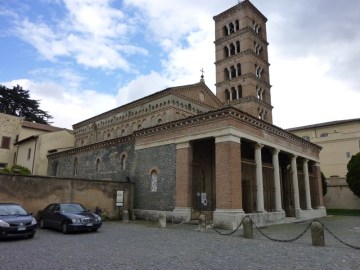
As you can see, the inside of the church is very Romanesque –

But there is a nice Iconostasis – note the presence of the choir stalls

A closer look at the Icon of the Blessed Mother – Byzantine and Baroque/Rococo:

This is the baptismal font:

One of the original mosaics:

The millennial icon of the Blessed Mother for the monastery:

You can find out more about the monastery at its web site.
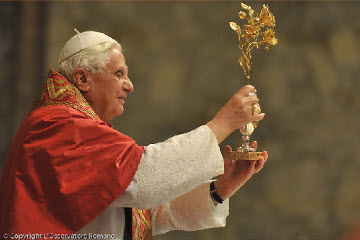
Laetare Sunday, also known as Dominica de Rosa, is probably best known for the rose – yes, rose – vestments the priest wears. This week, we take a look at how this tradition began and what it means for the spirituality of Lent.
Links:
Other examples of the Golden Rose
Photo from L’Osservatore Romano
Send e-mail questions and comments to catholicunderthehood@gmail.com or leave voice mail at 1 740 936 4354
To listen, just click on the link below:
#225 – Dominica de Rosa
February 22, 2010 – 3:43 am
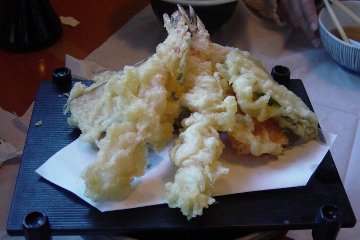
From the earliest days of the Christian Church, periods have been set aside for a “joyful fast” in remembrance of the gifts of God. Not only would these days increase Christian devotion through prayer and fasting, they would also have a significant influence on Japanese cuisine.
Ember Days for 2010:
February 24, 26, and 27 (the Wednesday, Friday, and Saturday after the First Sunday in Lent)
May 26, 28, and 29 (the Wednesday, Friday, and Saturday after the Feast of Pentecost)
September 15, 17, and 18 (the Wednesday, Friday, and Saturday after Holy Cross Day)
December 15, 17, and 18 (the Wednesday, Friday, and Saturday after December 13)
Links:
Ember Days article at fisheaters
Ember Days article at Family in Feast and Feria
Ember Days article at Rorate Caeli
Readings and Prayers for the Ember Days
Last year’s talk by Sr. Gaudia about the Divine Mercy
Send e-mail questions and comments to catholicunderthehood@gmail.com or leave voice mail at 1 740 936 4354
To listen, just click on the link below:
#224 – Ember Days


 catholicunderthehood.com