On 1 June 1494, Monk John Cor of Lindores Abbey recorded the first known reference to Scotch Whisky – “To Friar John Cor, by order of the King, eight bolls of malt wherewith to make aqua vitae .” “Aqua Vitae” or “Water of Life” was the name given to the local spirit. In Gaelic “aqua vitae” was “usquebaugh” which later became “uksy” and then “whisky”. Historians believe that “aqua vitae” was a term used by Saint Patrick both to refer to baptism as well as alcoholic spirits.
A boll was an old Scottish measurement about six bushels or 56 pounds. The amount of malt mentioned would be enough to make 1,500 bottles of whisky.
It was common for Benedictine monasteries to distill spirits which were seen as beneficial for health. For example, Benedictines in France were producing such spirits as Chartreuse. It was believed that whisky was an effective treatment for colic, palsy and small pox.
The Lindores Abbey was destroyed by the supporters of John Knox in 1559. But today special bottles of Scotch Whisky are being sold to raise funds to preserve the remains of the site.
Benedictine Abbey of Lindores
The History of Whisky
On 31 May 1821, the Basilica of the National Shrine of the Assumption of the Blessed Virgin Mary was consecrated in Baltimore, Maryland. The Basilica was the first Roman Catholic cathedral built in the United States.
The Basilica was built under the impetus of Bishop John Carroll and the architectural design of Benjamin Henry Latrobe. The building was intended to model the architectural style of the US capital and be seen as something “American”.
The seven pontifical councils and three plenary councils of the United States Catholic Church would take place at the Basilica, including those which established the Catholic University of America and commissioned the Baltimore Catechism.
As author George Weigel has said, “No other Catholic edifice in America can claim to have seen so much history made inside its walls.”
The Baltimore Basilica
On 30 May 1963, more than 500 Buddhist monks protested in front of the National Assembly in Saigon against the policy of the South Vietnamese government which promoted Catholicism but restricted Buddhism. While there had been a ban on public assembly, the monks evaded this ban by arriving at the National Assembly in buses with the blinds pulled down. The protest consisted of sitting for four hours while holding banners critical of the government.
While South Vietnam was composed 70 to 90 percent of Buddhists, the South Vietnamese government had enacted a very pro-Catholic policy. Catholics were favored for government positions, weapons were given only to Catholics, the Catholic Church was the largest landowner in the country, in 1959 Vietnam was dedicated to the Virgin Mary, and the Vatican flag was regularly flown at major public events in South Vietnam – however Buddhist flags were prohibited.
Opposition to the pro-Catholic policy and the restrictions on Buddhism motivated many protests which would reflect both political and religious problems in South Vietnam. The seriousness of these problems was graphically exemplified on 11 June 1963 when Buddhist monk Thích Quảng Đức immolated himself in front of a large crowd in South Vietnam in protest. Eventually, Buddhist opposition would contribute to the eventual coup against and assassination of South Vietnamese president President Ngô Đình Diệm.
The Buddhist Crisis
On 29 May 1982, Pope John Paul II became the first pontiff to visit the Canterbury Cathedral.
The pope described the visit as one “which centuries and generations have awaited”.
While there was some controversy because of the decision for the Pope to enter the Cathedral from a back door, because of “security and tiredness”, rather than the more ceremonial entrance – the Great West door – at the front of the cathedral; Peter Jennings described the visit to the Cathedral as “a hugely important step because here was the successor of St Peter coming to Britain really bridging a gap since the 400 years or more of the Reformation.”
While at Canterbury, the Holy Father and the Archbishop of Canterbury, Robert Runcie, renewed their baptismal vows together, lit candles for Christian martyrs and knelt in prayer before the spot where St Thomas-à-Becket was murdered in 1170. They also issued a common declaration thanking God for progress in the work of reconciliation between the Anglican and Catholic communities.
Homily of Pope John Paul II at the Canterbury Cathedral
On 28 May 1941, Maximillian Kolbe arrived at the Auschwitz concentration camp as prisoner #16670.
In July of 1941, in response to the disappearance of a prisoner from Kolbe’s barracks, the camp officials sentenced ten men to death by starvation in order to prevent further escape attempts – though the man who had disappeared was later found drowned in the latrine. One of the ten men selected, Franciszek Gajowniczek, cried out ‘My wife! My children!’ upon his selection and Kolbe volunteered to take his place.
Kolbe spent his time in his cell as he endured starvation in songs and prayer. After three weeks without water and food, Kolbe was the last of the ten men still alive. He was executed by an injection of carbolic acid on 14 August 1941.
An audio account of Kolbe’s death in Auschwitz by a fellow prisoner courtesy of The SaintCast
Shusako Endo’s book Silence describes the trials and persecutions of the Japanese Catholic Church during the late 1500s and 1600s. But what Endo describes in fiction, Fr. Cristóvão Ferreira, SJ found very real.
Links:
Hubert Cieslik, S.J. The Case of Christovao Ferreira. The true story behind Endo Shusaku’s best-selling novel Silence.
Silence by Shusaku Endo
SQPN’s Catholic New Media Celebration
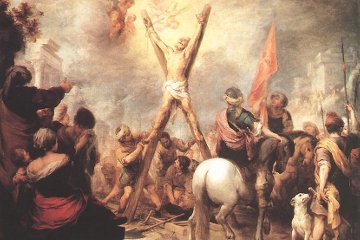
Painting – The Martyrdom of Saint Andrew by Bartolome Esteban Murillo
Be sure to check out the CUTH blog for more on the history of the Catholic Church
Send e-mail questions and comments to catholicunderthehood@gmail.com or leave voice mail at 1 740 936 4354
To listen, just click on the link below:
 #234 – Martyrdom and Apostasy
Guam News Watch has produced three short videos on the history of the Catholic Church in Guam which are worth watching:
Part I – The Blessed Diego
Part II – Santa Marian Kamalen – origins
Part III – Santa Marian Kamalen – WWII
On 27 May 1084, after an appeal from Pope Gregory VII, Norman duke Robert Guiscard entered Rome to defend Gregory from the forces of Holy Roman Emperor Henry IV and his anti-pope Clement III.
The roots of the conflict between Gregory and Henry lay in what was known as the Investiture Controversy, whether the secular ruler or the pope possessed the authority to appoint bishops within particular dioceses. Henry wished to appoint bishops within his empire and so placed a “pope” supportive to this view – Clement – in power at Saint Peter’s in Rome. Yet, as the conflict between Henry and Gregory grew, the issue of contention became more and more one concerned with the power of the papacy versus the power of the king.
At the time anti-pope Clement III was installed by Henry at Saint Peter’s, Gregory continued to resist Henry just a short distance away at Castel San Angelo. He asked for help from Robert Guiscard who responded by sending and army of 36,000 soldiers to enter Rome and rescue the pope. However, Guiscard’s armies also pillaged Rome for three days and partially burned the city – leading to the destruction many ancient buildings including the original basilica of San Clemente and the church of Santa Maria in Cosmodin.
Gregory died a year later in exile but his views on the secular primacy of the pope would be taken up by his successors while the support of Henry IV would decline.
Pope Gregory VII
On 26 May 451, the armies of the Sassanid Empire defeated the forces of Saint Vartan Mamigonian and the Armenians at the Battle of Avarayr. This day is considered one of the most important dates for the Armenian people.
On the fields of Avarayr, 66,000 Armenians faced off against 220,000 Sassanids. The Armenians were led by Saint Vartan, who died in the battle. Although the Armenians were defeated, the Sassanids experienced such heavy losses in the battle that continuing Armenian resistance would eventually lead to the granting of religious freedom in 484.
Moreover, since the Armenians were occupied with their struggles against the Sassanids, they were unable to send delegates to the Council of Chalcedon which would define the dyophysite [or dual] nature of Christ as true God and true Man. The Armenians would reject this council and its status as ecumenical and instead proclaim a miaphysitism which defined Christ has having only one nature in which the divinity and humanity of Christ are joined without confusion or alteration.
Today, the Armenian Orthodox Church remains separate both from the Catholic and the Eastern Orthodox Churches. Though there is an Armenian Catholic Church in communion with the Holy See.
Battle of Avarayr
On 25 May 1230, Brother Elias and some citizens of Assisi secretly moved the body of Saint Francis, which had been placed in the Basilica of Saint George in Assisi after the death of the saint, into the tomb which had been prepared for it in the recently completed Basilica of Saint Francis.
Elias feared that citizens from nearby Perugia might seek to steal the body and bury it in their own city. It was believed that the city and peoples of a city would gain blessings if the relics of a saint were buried there. Other examples of this belief in history can be seen in the presence of the relics of Saint Mark in Venice and Saint Nicholas in Bari.
The body of Francis was buried in a tomb deep underground, the tomb was covered with stone and over the stone was placed the high altar in order to prevent theft of his relics. Francis’ tomb was inaccessible until 1818 when, after a fifty two day search, the body of the saint was rediscovered.
The transfer of the body of Francis caused a controversy with Pope Gregory IX as there was to be a public transfer of the relics a few days later. The pope excommunicated the citizens of Assisi for moving the relics without episcopal authority and placed an interdict on the Basilica of Saint Francis – though these punishments were later rescinded.


 catholicunderthehood.com