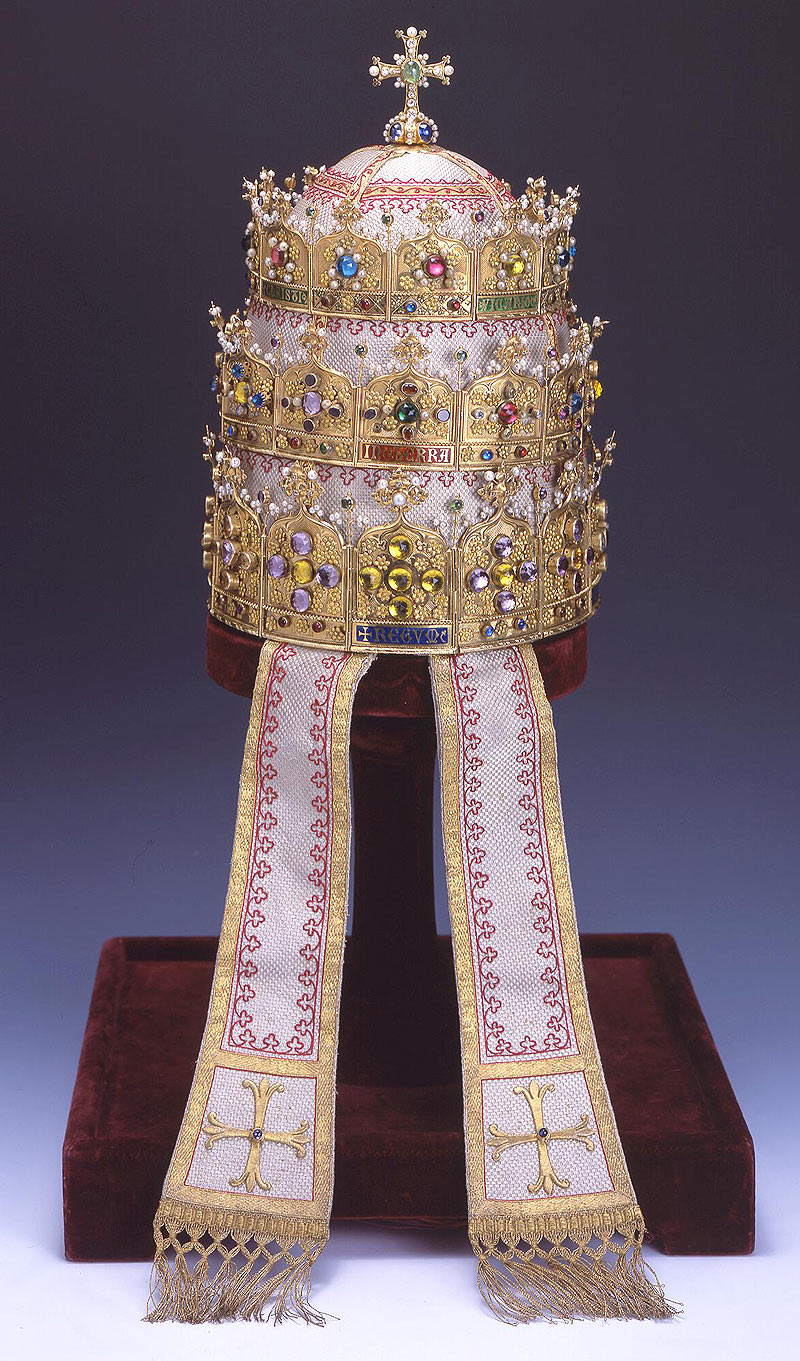
On 18 June 1871, the Ladies of the Royal Court of the King of the Belgians gave one of the most unique of Papal tiaras to Pius IX. The tiara was given in honor of the 25th anniversary of his pontificate. There is also some speculation that the tiara was given in response to the recent loss of Rome to the Kingdom of Italy.
The tiara, designed by Jean-Baptiste Bethune of Ghent is unusual not only in its conical shape but also because it contains the words CHRISTI VICARIO — IN TERRA — REGUM spread over its three crowns. It is made of gold, pearls, gilt silver, emeralds, enamel, agates and rubies. It is not known if the tiara was ever worn and no papal tiara has been worn since June 1963 when Pope Paul VI ceased to wear one.
Image of the Belgian Tiara
On 17 June 1839, King Kamehameha III issued an Edict of Toleration permitting Catholics in Hawaii to freely practice their religion which had been facing severe persecution.
Under the influence of Congregationalists from New England, Kamehameha III’s mother had been baptized and the Congregationalists encouraged a policy preventing the establishment of a Catholic presence in Hawaii. Catholic priests were forcibly expelled from the country on 24 December 1831. Native Hawaiian Catholics accused King Kamehameha and his government of imprisoning, beating and torturing them.
On 10 July 1839 a French frigate sailed into Honolulu Harbor on the justification that it was sent to protect the rights of the Catholic Church. Its captain had been ordered to:
Destroy the malevolent impression which you find established to the detriment of the French name; to rectify the erroneous opinion which has been created as to the power of France; and to make it well understood that it would be to the advantage of the chiefs of those islands of the Ocean to conduct themselves in such a manner as not to incur the wrath of France. You will exact, if necessary with all the force that is yours to use, complete reparation for the wrongs which have been committed, and you will not quit those places until you have left in all minds a solid and lasting impression.
King Kamehameha feared a French attack on his kingdom and so issued the Edict of Toleration permitting religious freedom for Catholics in the same way as it had been granted to the Protestants. King Kamehameha also donated land on which the first permanent Catholic church would be constructed, the Cathedral of Our Lady of Peace, and paid $20,000 in compensation to the Catholics who had been persecuted.
More on the Edict of Toleration in Hawaii
On 16 June 1846, Giovanni Maria Mastai-Ferreti, the Archbishop of Imola, was elected to the papacy on the fourth ballot. Upon his election he took the name of Pius IX.
Austrian Emperor Ferdinand had sent the Cardinal Karl Kajetan Gaisruck, the Archbishop of Milan [which at that time was part of the Austrian Empire] to veto the election of Ferretti because he was perceived to be too liberal.* However, by the time Gaisruck arrived at the conclave, Ferretti had already been publicly proclaimed to be the new pope.
Pius IX was crowned as pope on 21 June 1846 and would be the longest reigning pope since St. Peter. He served as pope for almost 32 years.
Although he had been chosen for the papacy with the reputation for liberalism, after the Revolutions of 1848 and his forced flight from Rome Pius IX would become a strong supporter of conservatism.
More on the Conclave of 1846
*There were several times at which a European ruler would try to veto the election of a particular candidate which they did not favor. While the cardinals at a papal conclave never officially recognized the rite of a secular ruler to veto a particular papal election, usually a vetoed candidate would not be chosen by the conclave. See Jus exlusivae
On 15 June 1520, Pope Leo X issued his bull Exsurge Domine, or Arise, O Lord, ordering Martin Luther to reject 41 errors or face excommunication. Leo X called for the public burning of any of Luther’s works containing these errors.*
Pope Leo X assigned the responsibility for publishing and distributing the bull in the Holy Roman Empire to Johan Eck. Eck was an adamant foe of Luther as well as the growing humanist movement in Germany. His presence combined with that of the harsh condemnations of Exsurge Domine caused much conflict in the Holy Roman Empire as both bishops and universities united against him. He was unable to publish the bull in several cities and indeed from a few was forced to flee for his life.
Martin Luther’s response to the bull of Leo X was to burn a copy of it along with several volumes of Canon Law, reportedly saying – “Because you have confounded the truth [or, the saints] of God, today the Lord confounds you. Into the fire with you!” On 3 January 1521, Leo X will excommunicate Luther with the bull Decet Romanum Pontificem. The bull which Leo X intended to bring Luther back into union with the Catholic Church instead to drove him further away.
The bull Exsurge Domine in English
An image of the Vatican’s copy of this bull
*Historian Hans J. Hillerbrand has questioned whether the bull accurately presented the ideas of Luther in these condemnations. Moreover, Jimmy Akin has shown the degree of difficulty in ascertaining how serious the condemnation in particular regards to any one of these 41 reputed errors.
On 14 June 1966, Pope Paul VI abolished the Index of Prohibited Books which had first been established by Pope Paul IV in 1559.
Paul IV established the Index Liborum Prohibitorum as part of the Catholic Counter-Reformation. Fearing that certain books might lead to the corruption of the faith and morals of the Catholic faithful, Paul IV wanted the Index to prohibit those writings deemed to contain errors of theology or morality. Works that would be listed on the Index included scientific works such as texts by Johannes Kepler and Galileo Galilei; philosophic works by Jean Paul Sartre and René Descartes; and literary works by Victor Hugo and John Milton. The writings of Saint Faustina were placed on the Index for twenty years, though the Vatican later determined that the writings were placed on the Index due to a faulty Italian translation of St. Faustina’s words.
Some works that one might think would be on the Index were not. For example, books that contained teaching explicitly contrary to Catholic doctrine were automatically forbidden for Catholics to read and some works did not end up on the list simply because no one denounced them. The works that were placed on the Index, often did so after much debate. Catholic authors who ended up on the Index had the opportunity to defend their writings or to modify and then re-publish their works.
By the mid-20th Century, it was becoming impossible for the Congregation of the Doctrine of the Faith to read all the books that were being published and the Index was less and less able to fulfill its function. Therefore, the Congregation stated that the Index would no longer be issued. Catholics are still encouraged to avoid those writings which might threaten faith or morality.
Authors who ended up on the Index of Prohibited Books

As the Year of the Priest comes to an end, CUTH takes a look at a priest, Fr. William J. Menster who truly preached the gospel unto the ends of the world – Antarctica.
Links:
Information on Operation Highjump
EWTN show times for the documentary about Fr. Menster “South Pole Padre”
Most of the information for this episode came from Fr. Menster’s Strong Men South published by the Bruce Publishing Company in 1949. Unfortunately, this book is out of print but some used copies do turn up on Amazon.com
SQPN’s Catholic New Media Celebration
Be sure to check out the CUTH blog for more on the history of the Catholic Church
Send e-mail questions and comments to catholicunderthehood@gmail.com or leave voice mail at 1 740 936 4354
To listen, just click on the link below:
 #236 – The Blessing of Antarctica
On 13 June 1691, an expedition of Spanish missionaries and explorers including Fr. Damian Massanet and Domingo Teran de los Rios, the leader of the expedition, arrived at the river and Payaya village which they would name “San Antonio” in honor of Saint Anthony of Padua whose feast is celebrated on this day.
Fr. Massenet wrote:
On this day, there were so many buffaloes that the horses stampeded and 40 head ran away. These were collected with the rest of the horses by hard work on the part of the soldiers. We found at this place the rancheria of the Indians of the Payaya nation. This is a very large nation and the country where they live is very fine. I called this place San Antonio de Padua, because it was his day. In the language of the Indians it is called Yanaguana [The Clean Water]….I ordered a large cross set up [on the 14th], and in front of it built an arbor of cottonwood trees, where the altar was placed. All the priests said mass…Then I distributed among them rosaries, pocket knives, cutlery, beads and tobacco. I gave a horse to the captain [the Payaya chief].
The first mission at San Antonio would not be established until 1718. This is the date usually understood as the founding of the city.
For more on this event
On 12 June 1915, Cardinal József Mindszenty was ordained to the priesthood in Csehimindszent, Austria-Hungary. Until 1941, he was known as József Pehm, but had adopted Mindszenty in honor of the village in which he was born.
Cardinal Mindszenty will spend much of his priesthood and religious life under the the persecution of the Nazis under Hitler and then under the persecution of the Communists after the end of the Second World War. On 8 February 1949, the Communist government of Hungary would sentence Cardinal Mindszenty to life imprisonment for treason after extracting from him a forced confession. On 12 February 1949, Pope Pius XII excommunicated anyone who had participated in the trial and conviction of the Cardinal.
On 30 October 1956, Cardinal Mindszenty would be released during the Hungarian Uprising. After the Soviet Union invaded Hungary to suppress the uprising, Mindszenty would seek asylum in the United States Embassy for fifteen years. On 28 September 1971, an agreement with Pope Paul VI led the Hungarian government to allow Mindszenty to leave Hungary in exchange for a Vatican agreement to declare Mindszenty a “victim of history” instead of “communism” and removing the excommunication imposed by Pius XII. Mindszenty would spend the rest of his life in Vienna, Austria. Mindszenty’s strong anti-communist views would cause problems in his relationship with the Vatican at this time which believed friendlier relations with the Soviet Union would help reduce the persecution of Catholics in Communist countries.
On 6 May 1975, Cardinal Mindszenty died. In 1991, his remains were repatriated to Esztergom, Hungary and buried in the Estrergom Basilica. There is a cause for his canonization.
For more on Mindszenty
On 11 June 1144, the Basilica of Saint Denis was completed and dedicated by Abbot Sugar in an area now part of Paris. The Basilica would become an important place of pilgrimage, the burial place of the French kings and the model of Gothic architecture in Northern Europe.
Saint Denis is the patron saint of France and, according to French tradition, was the first bishop of Paris. As such, his shrine at the Basilica of Saint Denis was a popular place for Catholics to visit.
Another reason for visiting the Basilica was to see the first major example of the “French Style” (Opus Francigenum) as it was known before it was more commonly called Gothic. Many of the memorable characteristics of the Basilica such as the Rose Window, the radiating chapels, and the flying buttresses had been used in Romesque style architecture before but Abbot Sugar was the first to pull these architectural characteristics all together. His placement of the Rose Window will be imitated in the construction of other French basilicas such as the Basilica of Chartres.
All but three of the French monarchs from the 10th century to 1789 are buried at the Basilica of Saint Denis. These monarchs were buried tombs containing effigies or images of the former king or queen contained in the tomb. Unfortunately, during the French Revolution the bodies of these monarchs were all removed from their tombs and buried in a common grave and after the revolution it was impossible to separate one body from another. Thus, the bodies of the French monarchs up to the French Revolution are now buried in a common ossuary. Fortunately, the effigies were preserved.
The art and architecture of Saint Denis
On 10 June 1190, Holy Roman Emperor Frederick I Barbarossa drowned in the Saleph [also known as the Calycadnus] River near Antioch. Some accounts claim that he drowned while bathing. Other accounts state that after Frederick fell from his horse while crossing the river, his head hit some rocks and drowned.
Frederick, along with French king Philip Augustus and English King Richard the Lionheart was leading the armies of the Third Crusade in the hopes of re-capturing the city of Jerusalem from the Muslims and their leader Saladin. But with his death, the soldiers of the Third Crusade fell into chaos as rivalries between Philip Augustus and Richard the Lionheart split the Crusaders apart. Much of the army of Frederick I would return to Germany. Unable to preserve the body of Frederick I in vinegar, his son Frederick V of Swabia will have the body boiled to remove the flesh of of Frederick Barbarosa from his bones. This was a typical treatment of fallen Crusaders as it was easier to transport just the bones of a dead Crusader rather than the entire body. However, this practice will eventually be condemned by the Pope Boniface VIII in 1300. While Frederick V hoped to bury the bones of his father in Jerusalem, he will be unable to do so and instead the bones will be buried in the city of Tyre.
Richard the Lionheart and his soldiers would later attempt to retake Jerusalem, but fail. This failure would lead to a call for a fourth crusade a few years later.
One account of the death of Frederick I


 catholicunderthehood.com