Today in Catholic History – The Arrest of Bishop Ignatius Kung Pin-Mei

On 8 September 1955, more than 200 Chinese Catholics including the Bishop of Shanghai Ignatius Kung Pin-Mei were arrested for their refusal to accept the “Three Autonomies” movement to separate the Catholic Church of China from the Holy See and Bishop Kung’s steadfast defense of the Catholic faith. Despite government opposition, Bishop Kung organized the establishment of the Legion of Mary and declared 1952 to be a Marian Year in Shanghai. Indeed, it was for participation in the Legion of Mary that most of the Chinese Catholics were arrested.

After his arrest, the Chinese authorities will try to get Bishop Kung to publicly confess his “crimes” at a stadium in Shanghai, instead the Bishop will shout out “Long live Christ the King! Long live the Pope!”. He will be sentenced to life imprisonment. Pope John Paul II would make him a cardinal in pectore in 1979 but Cardinal Kung would not learn this until 1988 after he had been released by the Chinese government. Cardinal Kung died on 12 March 2000 in Stamford, Connecticut.

An account of one priest who was arrested along with Cardinal Kung
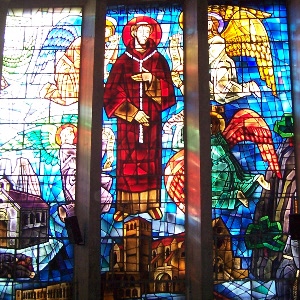
#244 – The Leonine Union

Struggling to live the life of St. Francis amidst the threats and temptations of the modern world, four groups of Franciscans had to decide if life together was better than life apart.

Links:
Image of the history of the divisions and union within the First Order of Saint Francis

Diagram of the Franciscan Family Tree showing the relationship of the First, Second and Third Orders of Saint Francis

Sources for this episode “The Leonine Union of the Order of Friars Minor 1897” and “The Franciscan Story: St. Francis of Assisi and His Influence Since the Thirteenth Century” both by Maurice Carmody.

Be sure to check out the CUTH blog for more on the history of the Catholic Church

Also check out the other great podcasts at the Starquest Production Network

Send e-mail questions and comments to catholicunderthehood@gmail.com

To listen, just click on the link below:

podcasticon#244 – The Leonine Union

Today in Catholic History – The Foundation of the Legion of Mary

On 7 September 1921, Frank Duff established the Legion of Mary in Dublin, Ireland as an association of catholic laity united in common devotion to the Blessed Virgin Mary.  It is the largest apostolic organization of Catholic laity in the world with more than three million active members worldwide.

Duff hoped that the Legion of Mary would help Catholics to life their baptismal promises in an organization united by fraternity and prayer.  Initially membership was reserved to women and men, other than Frank Duff himself, did not join the Legion until 1929. Life in Dublin had made him familiar with the struggles of the poor and saw a need for Catholics to offer and see material as well as spiritual nourishment.

Members are devoted to the Spiritual Works of Mercy through providing aid to all those in need both Catholic and non-Catholic.  Members are also encouraged to practice the Marian devotion exemplified by St. Louis de Monfort.

Prayer by Frank Duff

Oh, my God, I do not ask for the big things – the life of the missionary or the monk, or those others I see around me so full of accomplishment, I do not ask for any of these; but simply set my face to follow out unswervingly, untiringly, the common life which day to day stretches out before me, satisfied if in it I love You, and try to make you loved. Nature rebels against this life with its never-ending round of trivial tasks and full of the temptation to take relief in amusement or change. It seems so hard to be great in small things, to be heroic in the doing of the commonplace; but still this life is Your will for me. There must be a great destiny in it. And so, I am content. And then to crown the rest, dear Jesus, I beg you to give me this ,fidelity to the end, to be at my post when the final call comes, and to take my last, weary breath in Your embrace. A valiant life and faithful to the end. A short wish, dearest Jesus, but it covers all.

“Can we be Saints” by Frank Duff, age 27 years. Published 1916 with ecclesiastical approval

Website of the Legion of Mary

Today in Catholic History – The Destruction of the Church of the Life Giving Spring

On 6 September 1955, the Church of the Life Giving Spring in Istanbul/Constantinople was destroyed during a riot by Turkish Muslims.

The original Church of the Life Giving Spring had been built by Byzantine Emperor Leo I.  According to tradition, he had been looking for water to help a blind man when he heard a voice say to him, “Leo, Emperor, go into the grove, take the water which you will find and give it to the thirsty man. Then take the mud [from the stream] and put it on the blind man’s eyes…. And build a temple here … that all who come here will find answers to their petitions.”

After the Turks conquered Constantinople in 1453, the original Church of the Life Giving spring was torn down to build the mosque of Sultan Bayezid but Sultan Mahmud II gave permission in 1833 for the church to be rebuilt according to the original dimensions.

The riots of September 1955 were organized by the Turkish military in response to an earlier bombing of the birthplace of Mustafa Kemal Atatürk – the founder and first president of the Republic of Turkey.  While the Greeks had been blamed for the bombing, the individual responsible for the bombing was Turkish.  The government trucked Turks into Istanbul to attack the Greeks in the city and for nine hours the Turkish mob attacked Greeks, Jews and Armenians  – between 16 and 32 people were killed, including a priest, and many were severely wounded.  In addition to the Church of the Life Giving Spring, several other churches were desecrated.

After the destruction of the second church of the Life Giving Spring in 1955, a small chapel was rebuilt on the location of the original church and the faithful Orthodox and Eastern Catholics continue to visit the spring, believing that it has miraculous healing powers.

Today in Catholic History – John XXII is crowned as pope

On 5 September 1316 Jacques Duèze/John XXII was crowned in Lyon. John XXII was the second of the Avignon popes.

He did not have a peaceful papacy and was involved in political struggles with Holy Roman Emperor Louis IV. These struggles would divide the Church as the spiritual Franciscans and theologians such as Marsilius of Padua and Franciscan William of Ockham denied the primacy of the spiritual authority of the pope over that of the authority of the secular ruler. Louis IV would even try to establish an anti-pope in Rome.

John XXII also was involved in a controversy as to whether saints possessed the Beatific Vision.  John XXII argued that the souls of the saints did not see God until the Last Judgment. However, others argued that if the souls of saints were not in the presence of God than they could not offer the prayers of the faithful to Him. John XXII advocated his position in sermons but never in official documents. He would renounce his opinion on his death bed and later Pope Benedict XII will declare this view of John XXII to be heretical.

Pope John XXII has traditionally been credited with having written the prayer “Anima Christi”.


Anima Christi as written by Blessed John Cardinal Henry Newman

Soul of Christ, be my sanctification;
Body of Christ, be my salvation;
Blood of Christ, fill all my veins;
Water of Christ’s side, wash out my stains;
Passion of Christ, my comfort be;
O good Jesus, listen to me;
In Thy wounds I fain would hide;
Ne’er to be parted from Thy side;
Guard me, should the foe assail me;
Call me when my life shall fail me;
Bid me come to Thee above,
With Thy saints to sing Thy love,
World without end.
Amen.

Today in Catholic History – The Death of Fr. Vincent Capodanno

On 4 September 1967, Navy Chaplain Father Vincent Capodanno was killed by Northern Vietnamese gunfire as he ministered and gave last rites to wounded and dying US soldiers. Despite being seriously wounded in the face and hands, he went to help a wounded soldier just a short distance from an enemy machine gun – which shot and killed him.

Fr. Capodanno, or as the soldiers called him “The Grunt Padre” had already been wounded twice before during his time in Vietnam when he volunteered to travel with a Marine unit being sent to the dangerous Que Son Valley. After his unit of 500 soldiers arrived at the valley, it was attacked by a force of 2,000 North Vietnmanese. Despite being outnumbered, Fr. Capodanno stayed with his unit until his death, encouraging the soldiers and offering both physical and spiritual assistance.

Fr. Capodanno would posthumously be awarded the Medal of Honor and his cause for canonization has been opened. The frigate USS Capodanno has been named after him. The USS Capodanno was the first ship the US fleet to receive a papal blessing.

For more on Servant of God, Fr. Vincent Capodanno

Today in Catholic History – The Founding of San Marino

On 3 September 301, Saint Marinus established the country of San Marino – the fifth smallest state in the world.

Saint Marinus, at this time known as Marinus the Dalmatian, had fled to Mount Titano to escape the persecution of the Emperor Diocletian. Mount Titano is the highest mountain in San Marino and there, on land given to him by the Riminese noblewoman Felicissima, Marinus established a small Christian monastery. Felicissima urged the followers of Marinus to remain always in unity. After Saint Marino’s death, the community which grew out of the monastery became known as the Land of San Marino and today as the Republic of San Marino.

Today is a national holiday for San Marino, you too can celebrate with a Bustrengo.

Today in Catholic History – The September Massacres

On 2 September 1792, French revolutionaries in Paris gravely concerned over the approaching armies of Prussians and believing that the Catholic Clergy were an unreliable support, attacked and killed many Catholic clergy and religious.

At a Carmelite convent, 150 priests were massacred, including Bl. Severin Girault, a member of the Third Order of St. Francis. Bl. Severin and the other priests at the Carmelite convent had been imprisoned there by the French Revolutionary government for refusing to take the oath of loyalty to the French Revolution.

Over the next several days other Catholics would be killed – including 200 priests and three bishops. Many of those who lost their lives would be beatified in 1926.

Today in Catholic History – Pope Gregory X is elected Pope

0n 1 September 1271, Pope Gregory X was elected Pope at the end of what would be the longest papal election in history. It will also be the first example of a Papal election by compromise and lead Gregory X to issue reforms in the selection process of new popes to ensure that such a long delay in the election of a new pontiff was not repeated.

Cardinals began the process of electing a successor to Pope Clement IV in November 1268 but were divided between French and Italian cardinals – each of whom hoped to elect one of their number. Once each day the cardinals would meet at the Viterbo Cathedral to vote. After months of deadlock, the Podesta of Viterbo ordered the cardinals to be sequestered until a new pope was elected. The diet of the cardinals was reduced to bread and water and the roof of the papal palace was removed, all to encourage the cardinals to more quickly choose a new pope. Under pressure from King Philip III, the cardinals would eventually form a committee of six who would agree to elect Tebaldo Visconti as Clement IV’s successor.

Clement X in his Apostolic Constitution Ubi Periculum required the sequestration of cardinals for future papal elections and a limit on the food provided the cardinals if they did not choose a new pope within three days. Pope John XXI would later revoke Ubi Periculum.

Today in Catholic History – The First Mass for the Feast of the Sacred Heart

On 31 August 1670, the first feast of the Sacred Heart Mass was celebrated at the Grand Seminary of Rennes. With this Mass, the devotion of the Sacred Heart of Jesus became a public devotion for the whole Catholic Church.

St. John Eudes had played a key role in spreading devotion to the Sacred Heart of Jesus. Though the devotion can be traced to the earlier writings of Sts. Bernard of Clairvaux, Bonaventure and Gertude and the Church Fathers. A key theme for the celebration of the Feast of the Sacred Heart would be the love of Jesus for all humanity.

In 1856, Pope Pius IX will make celebration of the Feast of the Sacred Heart obligatory. Pius XII would raise the Feast to the status of a Solemnity. The Feast of the Sacred Heart has become particularly linked to the priesthood and the recent Year of the Priest began on the Solemnity of the Sacred Heart.