Category Archives: Papal History

Today in Catholic History – Pius IX approves the Red Scapular

On 25 June, Pius IX approved the Red Scapular of the Passion of Our Lord and the Sacred Hearts of Jesus and Mary for use as a sacramental.

The scapular is made of red wool with one side bearing the image of the crucifix, instruments of the Passion and the words “Holy Passion of Our Lord Jesus Christ Save Us.” The other side bears an image of a small cross above the Sacred Heart Jesus and the Immaculate Heart of Mary and the words “Sacred Hearts of Jesus and Mary, protect us.”

Sister Appoline Andriveau of the Sisters of Charity claimed that the devotion of the Red Scapular was revealed to her during a series of visions of Jesus and Mary in 1846. Sister Appoline said that she was promissed that those who wear the scapular faithfully and contemplated the Passion of Jesus Christ would grow in faith, hope, and charity.

Pope Pius IX, in approving the use of the Red Scapular, also granted with it various indulgences. Originally the Lazarist Order was responsible for blessing and investing someone with the Red Scapular, but now any priest can do so.

For more on scapulars and the Red Scapular

Today in Catholic History – Pope Clement VII confirms the Order of the Theatines

On 24 June 1524, Pope Clement VII approved the establishment of the Theatine Order in his Brief Exponi Nobis.

The Theatines were founded by Saint Cajetan, Paolo Consiglieri, Bonifacio da Colle, and Giovanni Pietro Carafa and named after the Italian city Chieti/Theate where Carafa was Bishop. The order was consecrated to the Cross and Saint Cajetan and the other Theatines will make their profession before the pope on September 14th – the Feast of the Holy Cross.

The main charism of the Theatines was to encourage both clergy and laity in the practice of virtue. One of the reasons for the establishment of the Theatines was in response to the attacks of Martin Luther and the Protestant Reformation.

The Theatines accomplished much good work with their oratories and missions and include in their number one pope – Paul IV. However, the mid-late 19th century suppression of religious orders struck the Theatines particularly harshly. The Theatines vow of poverty prohibited them from owning any property and so was left with very little when their order was disolved many parts of Europe.

There are also Theatine Sisters and it was through Venerable Ursula Benincasa, who founded the Order of Theatine Nuns, that the devotion of the Blue Scapular of the Immaculate Conception was established.

Today in Catholic History – Bishop Karol Wotyła ordains Stanisław Dziwisz

On 23 June 1963, Stanisław Dziwisz was ordained to the priesthood for the Archdiocese of Krakow by Bishop Karol Wojtyła.

He will serve briefly as a parish priest before becoming the personal secretary of Wojtyła in October 1966 – a position he will hold until the death of Pope John Paul II in 2005. On 3 June 2005, Dziwisz will become the Archbishop of Krakow and a cardinal on the 24 March 2006.

George Weigel will describe the relationship between Pope John Paul II and Cardinal Dziwisz as “that which every father wants from a son: love and duty without fear or synchophany. Dziwisz brought complete loyalty, utter discretion, sharp judgement, a puckish sense of humor, and indefatigability to the job.”

More on Cardinal Stanisław Dziwisz

Today in Catholic History – Condemnation of Galileo

On 22 June 1633, Galileo was condemned by the Roman Inquisition.

In 1616, the Roman Inquisition had acted against Galileo for these reasons : holding the doctrine that the sun is at the center of the universe and immovable and that the earth moves; teaching and writing about this belief to others; for publishing a book presenting this doctrine and for expressing a doctrine which was contrary to the true sense and authority of Holy Scripture.

He was ordered to abandon this doctrine and to no longer teach it. All books which presented this doctrine were to be prohibited. Galileo agreed with the Inquisition’s decisions and did not discuss these ideas for sixteen years.

But in 1632, he published a book, “Dialogue of Galileo Galilei on the Great World System,” which the Inquisition deemed violated Galileo’s earlier promise. Therefore, the Inquisition ordered that Galileo was to formally reject the doctrine that the sun was immovable and the center of the universe and that the earth moved, the offending book was to be prohibited, he was placed under house imprisonment, and each week for three years was to repeat the seven penitential Psalms.

On 31 October 1992, Pope John Paul II apologized for the condemnation of Galileo.

The text of the condemnation of Galileo

#237 – Peter’s Pence

Every year the the Catholic Church asks Catholics to aid those in need through Peter’s Pence. This collection has changed somewhat since its 8th century beginnings but still seeks to help the poor.

Links:
Vatican website on Peter’s Pence with information on contributing on-line
In the United States, you can also send contributions to:

Peter’s Pence Collection
The Apostolic Nunciature
3339 Massachusetts Ave., NW
Washington, DC 20008

The USCCB’s website with more information on this year’s Peter’s Pence collection

Sources for this episode –

Rupert Klieber. “Efforts and Difficulties in Financing the Holy See by Means of Peter’s Pence. Can Ultramontanism be quantified?” in The Papacy and the New World Order. Vatican Diplomacy, Catholic Opinion and International Politics at the Time of Leo XIII. ed. Vincent Viane. Leuven University Press. 2005. pp. 287-302

John F. Pollard. Money and the Rise of the Modern Papacy. Financing the Vatican, 1850-1950. Cambridge University Press Cambridge 2005

SQPN’s Catholic New Media Celebration

Be sure to check out the CUTH blog for more on the history of the Catholic Church

Send e-mail questions and comments to catholicunderthehood@gmail.com or leave voice mail at 1 740 936 4354

To listen, just click on the link below:

podcasticon#237 – Peter’s Pence

Today in Catholic History – Pius IX receives the Belgian Tiara

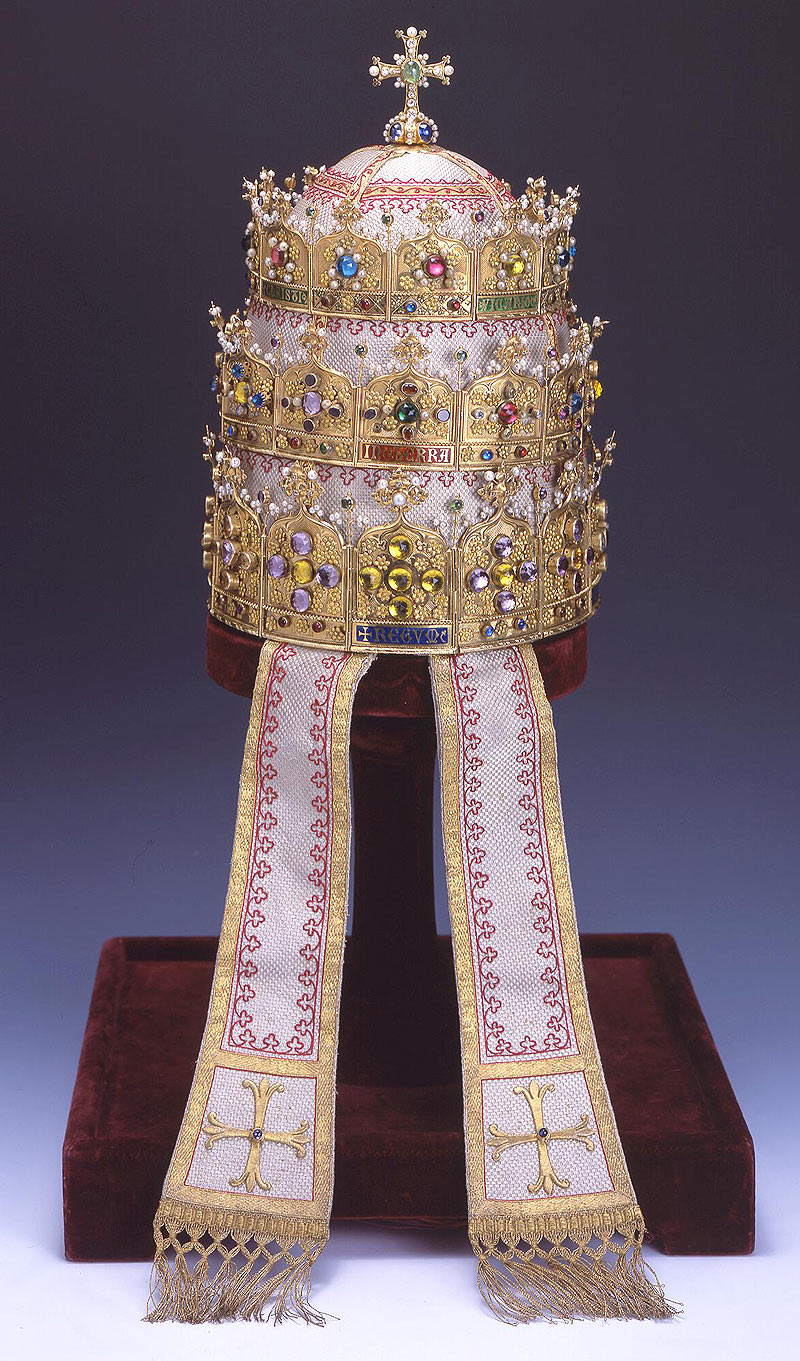
On 18 June 1871, the Ladies of the Royal Court of the King of the Belgians gave one of the most unique of Papal tiaras to Pius IX. The tiara was given in honor of the 25th anniversary of his pontificate. There is also some speculation that the tiara was given in response to the recent loss of Rome to the Kingdom of Italy.

The tiara, designed by Jean-Baptiste Bethune of Ghent is unusual not only in its conical shape but also because it contains the words CHRISTI VICARIO — IN TERRA — REGUM spread over its three crowns. It is made of gold, pearls, gilt silver, emeralds, enamel, agates and rubies. It is not known if the tiara was ever worn and no papal tiara has been worn since June 1963 when Pope Paul VI ceased to wear one.

Image of the Belgian Tiara

Today in Catholic History – Pius IX elected to the papacy

On 16 June 1846, Giovanni Maria Mastai-Ferreti, the Archbishop of Imola, was elected to the papacy on the fourth ballot. Upon his election he took the name of Pius IX.

Austrian Emperor Ferdinand had sent the Cardinal Karl Kajetan Gaisruck, the Archbishop of Milan [which at that time was part of the Austrian Empire] to veto the election of Ferretti because he was perceived to be too liberal.* However, by the time Gaisruck arrived at the conclave, Ferretti had already been publicly proclaimed to be the new pope.

Pius IX was crowned as pope on 21 June 1846 and would be the longest reigning pope since St. Peter. He served as pope for almost 32 years.

Although he had been chosen for the papacy with the reputation for liberalism, after the Revolutions of 1848 and his forced flight from Rome Pius IX would become a strong supporter of conservatism.

More on the Conclave of 1846

*There were several times at which a European ruler would try to veto the election of a particular candidate which they did not favor. While the cardinals at a papal conclave never officially recognized the rite of a secular ruler to veto a particular papal election, usually a vetoed candidate would not be chosen by the conclave. See Jus exlusivae

Today in Catholic History – Pope Leo X issues the bull Exsurge Domine against Martin Luther

On 15 June 1520, Pope Leo X issued his bull Exsurge Domine, or Arise, O Lord, ordering Martin Luther to reject 41 errors or face excommunication. Leo X called for the public burning of any of Luther’s works containing these errors.*

Pope Leo X assigned the responsibility for publishing and distributing the bull in the Holy Roman Empire to Johan Eck. Eck was an adamant foe of Luther as well as the growing humanist movement in Germany. His presence combined with that of the harsh condemnations of Exsurge Domine caused much conflict in the Holy Roman Empire as both bishops and universities united against him. He was unable to publish the bull in several cities and indeed from a few was forced to flee for his life.

Martin Luther’s response to the bull of Leo X was to burn a copy of it along with several volumes of Canon Law, reportedly saying – “Because you have confounded the truth [or, the saints] of God, today the Lord confounds you. Into the fire with you!” On 3 January 1521, Leo X will excommunicate Luther with the bull Decet Romanum Pontificem. The bull which Leo X intended to bring Luther back into union with the Catholic Church instead to drove him further away.

The bull Exsurge Domine in English
An image of the Vatican’s copy of this bull

*Historian Hans J. Hillerbrand has questioned whether the bull accurately presented the ideas of Luther in these condemnations. Moreover, Jimmy Akin has shown the degree of difficulty in ascertaining how serious the condemnation in particular regards to any one of these 41 reputed errors.

Today in Catholic History – The Index of Prohibited Books is Abolished

On 14 June 1966, Pope Paul VI abolished the Index of Prohibited Books which had first been established by Pope Paul IV in 1559.

Paul IV established the Index Liborum Prohibitorum as part of the Catholic Counter-Reformation. Fearing that certain books might lead to the corruption of the faith and morals of the Catholic faithful, Paul IV wanted the Index to prohibit those writings deemed to contain errors of theology or morality. Works that would be listed on the Index included scientific works such as texts by Johannes Kepler and Galileo Galilei; philosophic works by Jean Paul Sartre and René Descartes; and literary works by Victor Hugo and John Milton. The writings of Saint Faustina were placed on the Index for twenty years, though the Vatican later determined that the writings were placed on the Index due to a faulty Italian translation of St. Faustina’s words.

Some works that one might think would be on the Index were not. For example, books that contained teaching explicitly contrary to Catholic doctrine were automatically forbidden for Catholics to read and some works did not end up on the list simply because no one denounced them. The works that were placed on the Index, often did so after much debate. Catholic authors who ended up on the Index had the opportunity to defend their writings or to modify and then re-publish their works.

By the mid-20th Century, it was becoming impossible for the Congregation of the Doctrine of the Faith to read all the books that were being published and the Index was less and less able to fulfill its function. Therefore, the Congregation stated that the Index would no longer be issued. Catholics are still encouraged to avoid those writings which might threaten faith or morality.

Authors who ended up on the Index of Prohibited Books

Today in Catholic History – Clement XVI issues Cum Primum (On Civil Obedience) in response to uprising in Poland

On 9 June 1832, Pope Clement XVI issued his encyclical Cum Primum concerning the 1830-31 Polish uprising against Russian occupation.

Clement XVI condemned a rebellion against the “legitimate authority” by those operating “under the pretext of religion.” He urged the Polish Catholics to remain obedient to the Russian government in civil matters because “Your emperor will act kindly toward you; at no time will he deny his patronage for the good of the Catholic religion and he will always listen patiently to your requests.”

Many Polish Catholics felt this encyclical to be a betrayal, that Clement XVI had preferred to support the non-Catholic Russian Emperor over the Pole who had long defended the Catholic Church. Thus, the encyclical severely damaged relations between the Polish Catholics and the Vatican. Indeed some historians argue that a restoration of Polish Catholic faith in the Vatican did not return until the papacy of Pope John Paul II.

Gregory XVI did not condemn the Polish rebellion directly. Instead he offered general condemnation against any attack on “legitimate authority”. Clement XVI had witnessed first-hand the effects of revolution in 1831 in the Papal States. He had depended on the support and assistance of the Austrian Empire to restore his authority and had come to oppose all revolution wherever it took place.

Moreover, Clement XVI hoped that by trying to show that the Vatican supported Russian political authority, Tsar Nicholas I would permit the free exercise of the Catholic faith in Poland. Clement believed that Nicholas was in full control of Poland and calling for further resistance to Russia would be hopeless and only encourage further repression. The best policy would be to attempt to convince Nicholas of Polish loyalty in the hopes that he would not act against the Polish Church. This hope was not fulfilled and when Nicholas I continued to attack the Catholic Church in Poland, Clement XVI became much more critical of Russia saying in 1836 that “Catholicism has no more greater and more cruel foe than Nicholas I”.

See “Metternich, Pope Gregory XVI, and Revolutionary Poland, 1831-1842” by Alan J. Reinerman in The Catholic Historical Review, Vol. 86, No. 4 (Oct., 2000), pp. 603-619 available here in .pdf format