September 27, 2010 – 9:25 am
On 27 September 1590, Pope Urban VII died ending the shortest papacy in history of only thirteen days. He died from malaria before his coronation as pope.
At this time, Rome was plagued with the problem of malaria. Popes Damasus II, Leo X, Gregory V, and Sixtus V are also believed to have died from the “Roman fever”.
Despite his brief reign, Urban VII is known for instituting the first known ban on public smoking. He threatened to excommunicate anyone who “took tobacco in the porchway of or inside a church, whether it be by chewing it, smoking it with a pipe or sniffing it in powdered form through the nose.” He gave his entire estate to the Archconfraternity of the Annunciation to be used as dowries for poor girls.
September 23, 2010 – 12:09 pm
On 23 September 1122, Pope Calixtus II and Holy Roman Emperor Henry V agreed to the Concordat of Worms or the Pactum Calixtinum which temporarily resolved the struggle between the papacy and the Holy Roman Emperors regarding the appointment and power of monks and bishops.
Prior to the Concordat, the secular ruler was seen as possessing the right to invest bishops with both secular and sacred authority. The ability of the secular ruler to appoint bishops was an important means of exercising political control. Bishops could be placed in charge of royal lands without worrying that those lands might fall into the hands the bishop’s descendants. However, it also meant that the Church’s liberties with respect to the secular rule were much curtailed.
As a result of the Concordat, the secular ruler continued to invest bishops with secular power but no longer with sacred authority. The Concordat was also instrumental as part of the Gregorian reforms which gained greater independence for the pope in his relations with the Holy Roman Emperor.
The Concordat did not end the struggle between secular and religious authority in regards to authority either in the Holy Roman Empire or in Europe as a whole, it was simply a temporary cessation of hostilities.
September 22, 2010 – 9:32 am
On 22 September 530, Boniface II was consecrated to the papacy in the Lateran Palace in Rome and Dioscorus was consecrated in the Lateran Basilica.
Boniface II had been the candidate of Pope Felix IV. Dioscorus had been chosen by sixty of the sixty seven priests of Rome. The priests of Rome were concerned that Boniface, an Ostrogoth, would permit too much Ostrogothic influence in Rome. The Ostrogoths had earlier influenced the papal election of Felix IV.
The conflict between the two claimants would be resolved when Dioscorus died 22 days later and Boniface would be accepted by the Roman clergy as well. Boniface would later require those who had supported Dioscorus to condemn his memory. However Pope Agapetus I would later lift this condemnation.
The conflict between Boniface and Dioscorus was part of the increasing struggle between the Germanic Ostrogoths and the Byzantines for control of Rome.
September 19, 2010 – 10:00 am
On 19 September 1870, the armies of the Kingdom of Italy laid siege to Rome in their desire to incorporate the city into a unified Italian state. On the 20th of September, the Italian armies will capture the city ending more than one thousand years of temporal rule by the papacy. Popes Pius IX through Pius XI will refuse to recognize the loss of Rome and call themselves the “Prisoner of the Vatican”.
With the defeat of Napoleon III at the Battle of Sedan, the French Government was no longer willing or able to prevent the desires of many Roman citizens as well as the Italian Government itself that Rome become part of the Kingdom of Italy. An attempt by King Victor Emmanuel III to get Pope Pius IX to acquiesce to Italian troops marching into Rome under the guise of protecting the Pope was rejected. The Italian government hoped that a peaceful surrender could be negotiated and as the Italian army approached Rome, Pius IX recognized that he could not defend the city but would put up a token resistance.
On 19th of September, the Italian army reached the Aurelian Walls of Rome. On 20th, Italian troops will enter Rome and after a brief struggle during which 68 soldiers were killed, Italy captured the city. On the 21st, the Italian forces will capture the Leonine City, including the Vatican. The Italian government had attempted to offer a deal to Pius IX to offer the Leonine City in return for his recognition of the loss of Rome but Pius IX refused.
For the next 59 years, the popes refused to give any sign that they recognized the authority of the Italian government. They would not appear in Saint Peter’s Square or leave the Vatican. Only when Pope Pius XII agreed to the Lateran Treaty in 1929 establishing an independent Vatican City did this situation change.
September 17, 2010 – 11:23 am
On 17 September 1228, Pope Gregory IX answered Saint Clare’s request for the Privilegium Paupertatis. This was a modification of the 1219 Rule for the Poor Clares through which Gregory granted that the Poor Clares could not be forced to accept property.
For Clare, living the poverty of Christ as exemplified in the life of Saint Francis was a necessary element of her own community. However, the Catholic authorities greatly doubted that a community of women could survive without material wealth. Thus, there were many attempts to get Clare to accept property so as to provide her community with support. However, Clare believed that accepting property would mean a rejection of the total dependence that she and her sisters wanted to have upon Christ.
That Clare was able to obtain this privilege which had never been granted before or has been granted since is a testament to the authority and respect that Clare possessed.
September 13, 2010 – 10:13 am
On 13 September 604, Pope Sabinian was consecrated pope. Not much is known about his papacy which lasted only until 22 February 606.
Some records allege that he introduced the practice of ringing bells during the canonical hours and the celebration of the Eucharist.
There was a famine in Rome during his papacy, but Sabinian sold rather than give away the Vatican grain supplies. This caused some anger in Rome against him, especially since his predecessor, Gregory I, had given the grain away for free. Indeed, there is a legend that the spirit of Gregory would appear to Sabinus in his dreams condemning Sabinus and would eventually cause Sabinus’ early death.
He also returned secular clergy to the positions in the Vatican that his predecessor filled with monks.
September 7, 2010 – 2:41 pm
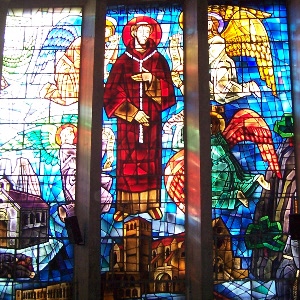
Struggling to live the life of St. Francis amidst the threats and temptations of the modern world, four groups of Franciscans had to decide if life together was better than life apart.
Links:
Image of the history of the divisions and union within the First Order of Saint Francis
Diagram of the Franciscan Family Tree showing the relationship of the First, Second and Third Orders of Saint Francis
Sources for this episode “The Leonine Union of the Order of Friars Minor 1897” and “The Franciscan Story: St. Francis of Assisi and His Influence Since the Thirteenth Century” both by Maurice Carmody.
Be sure to check out the CUTH blog for more on the history of the Catholic Church
Also check out the other great podcasts at the Starquest Production Network
Send e-mail questions and comments to catholicunderthehood@gmail.com
To listen, just click on the link below:
 #244 – The Leonine Union
September 5, 2010 – 2:00 pm
On 5 September 1316 Jacques Duèze/John XXII was crowned in Lyon. John XXII was the second of the Avignon popes.
He did not have a peaceful papacy and was involved in political struggles with Holy Roman Emperor Louis IV. These struggles would divide the Church as the spiritual Franciscans and theologians such as Marsilius of Padua and Franciscan William of Ockham denied the primacy of the spiritual authority of the pope over that of the authority of the secular ruler. Louis IV would even try to establish an anti-pope in Rome.
John XXII also was involved in a controversy as to whether saints possessed the Beatific Vision. John XXII argued that the souls of the saints did not see God until the Last Judgment. However, others argued that if the souls of saints were not in the presence of God than they could not offer the prayers of the faithful to Him. John XXII advocated his position in sermons but never in official documents. He would renounce his opinion on his death bed and later Pope Benedict XII will declare this view of John XXII to be heretical.
Pope John XXII has traditionally been credited with having written the prayer “Anima Christi”.
Anima Christi as written by Blessed John Cardinal Henry Newman
Soul of Christ, be my sanctification;
Body of Christ, be my salvation;
Blood of Christ, fill all my veins;
Water of Christ’s side, wash out my stains;
Passion of Christ, my comfort be;
O good Jesus, listen to me;
In Thy wounds I fain would hide;
Ne’er to be parted from Thy side;
Guard me, should the foe assail me;
Call me when my life shall fail me;
Bid me come to Thee above,
With Thy saints to sing Thy love,
World without end.
Amen.
September 1, 2010 – 10:10 am
0n 1 September 1271, Pope Gregory X was elected Pope at the end of what would be the longest papal election in history. It will also be the first example of a Papal election by compromise and lead Gregory X to issue reforms in the selection process of new popes to ensure that such a long delay in the election of a new pontiff was not repeated.
Cardinals began the process of electing a successor to Pope Clement IV in November 1268 but were divided between French and Italian cardinals – each of whom hoped to elect one of their number. Once each day the cardinals would meet at the Viterbo Cathedral to vote. After months of deadlock, the Podesta of Viterbo ordered the cardinals to be sequestered until a new pope was elected. The diet of the cardinals was reduced to bread and water and the roof of the papal palace was removed, all to encourage the cardinals to more quickly choose a new pope. Under pressure from King Philip III, the cardinals would eventually form a committee of six who would agree to elect Tebaldo Visconti as Clement IV’s successor.
Clement X in his Apostolic Constitution Ubi Periculum required the sequestration of cardinals for future papal elections and a limit on the food provided the cardinals if they did not choose a new pope within three days. Pope John XXI would later revoke Ubi Periculum.
August 29, 2010 – 8:11 pm

Abraham Abufalia believed God wanted him to convert Pope Nicholas III to Judaism and help bring about the coming of the Messiah. Perhaps not surprisingly, the Franciscans were also involved.
Links:
Earlier CUTH podcast on Joachim of Fiore and the Francisans
An important source for this episode was Harvey James’ Like Angels on Jacob’s Ladder: Abraham Abulafia, the Franciscans, and Joachimism
Photo of Pope Nicholas III’s palace at Soriano by NicFer
Be sure to check out the CUTH blog for more on the history of the Catholic Church
Also check out the other great podcasts at the Starquest Production Network
Send e-mail questions and comments to catholicunderthehood@gmail.com or leave voice mail at 1 740 936 4354
To listen, just click on the link below:
#243 – Converting a Pope


 catholicunderthehood.com

