Category Archives: Early Church History

#257 – Church and Empire

The incarnation of Christ greatly influenced our understanding of history. In turn, the development of history has greatly influenced our understanding of God’s activity in the world. Perhaps the clearest example of this was the relationship of Christianity and the Roman Empire.

Links:
Catholic audio lectures for the iPhone and Android

Sources:
Breisach, Ernst. Historiography: Ancient Medieval, and Modern. 2007.
Chestnut, Glenn F. The First Christian Histories: Eusebius, Socrates, Sozomen, Theodoret, and Evagrius. 1986.
Daly, Christopher T., ed. Augustine and History. 2007.

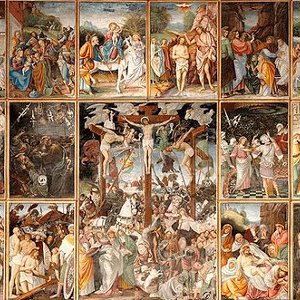
Photo “Stories of life and passion of Christ” by Gaudenzio Ferrari

CNMC – Catholic New Media Celebration

Check out the other great podcasts at the Starquest Production Network

Send e-mail questions and comments to catholicunderthehood@gmail.com

To listen, just click on the link below:

podcasticon#257 – Church and Empire

Today in Catholic History – The death of Boethius

On 23 October 524, Anicius Manlius Severinus Boëthius,commonly called Boethius, was executed by Ostrogoth king Theodoric the Great.

Boethius is famous for his contributions to philosophy and theology, especially for his work The Consolation of Philosophy which stressed that despite the sufferings of this world that there was a higher power which guided all things for good. Boethius’ translations of Aristotle were the only known works of Aristotle known in Western Europe until the 12th century. His other works proved to be instrumental in passing the knowledge of Ancient Greece and Rome to future generations. His theological works defended orthodox Christianity against Arianism and Nestorianism.

Ostrogoth king Theodoric accused Boethius of plotting with Byzantine Emperor Justin I against him and ordered him executed.

Boethius is considered a saint and martyr in the Catholic Church because he defended orthodox Christianity against the Arianism of Theodoric and this was believed to have been the reason for Boethius’ death.

“Boethius, the symbol of an immense number of people unjustly imprisoned in all ages and on all latitudes, is in fact an objective entrance way that gives access to contemplation of the mysterious Crucified One of Golgotha.” – Benedict XVI

Today in Catholic History – The Martyrdom of St. Theodoret of Antioch

On 22 October 362, St. Theodoret of Antioch was martyred under the reign of Roman Emperor Julian the Apostate.

Theodoret had refused to turn over the treasury of one of the Antiochean churches to the Roman authorities and was arrested. When Theodoret was brought before the Roman governor of Syria also named Julian, Theodoret condemned the apostasy of the governor who had abandoned Christianity and returned to paganism. Theodoret was tortured and later condemned to be killed by beheading.

There is a Christian tradition that Theodoret prophesied the death of Emperor Julian in battle against the Sassanid Empire.

Today in Catholic History – The Second Council of Nicaea

On 24 September 787, 350 clergy met in Nicea at what would become the Second Council of Nicea and the Seventh Ecumenical Council.

The main objective of the council was to address the schism between East and West over Iconoclasm heresy. In 754, the Council of Hieria had condemned the veneration of icons but the council was not recognized by the Pope or any of the Eastern Patriarchs. As a result of the advocacy of Iconoclasm by Byzantine Emperors Leo VI and Constantine V, Rome had broken with Constantinople.

However after the death of Constantine V, Byzantine Empress Irene, and Patriarch of Constantinople Tarasius sought both to reunite Rome and Constantinople and to restore the veneration of icons. Pointing to support from the scriptures and the Church Fathers, the Second Council of Nicea proclaimed that it was fitting and praiseworthy to venerate icons as the honor given to an icon was truly offered to the saint, angel, or Christ represented by the icon.

#245 – Praise God At All Times

From the earliest days of the Catholic Church, hymns sung in worship expressed the faith of Christians. Two of the earliest hymns the Phos Hilaron and the Oxyrhynchus Hymn show clearly the obligation that Christians had to offer praise to God and to express their thanksgiving in song.

Links:
Youtube video of the Phos Hilaron in Greek
Youtube video of the Oxyrhynchus Hymn
Photo of the Oxyrhychus Hymn fragment

Photo by J. Samuel Burner

Be sure to check out the CUTH blog for more on the history of the Catholic Church

Also check out the other great podcasts at the Starquest Production Network

Send e-mail questions and comments to catholicunderthehood@gmail.com

To listen, just click on the link below:

podcasticon#245 – Praise God At All Times

Today in Catholic History – The Council of Agde

On 10 September 506, twenty four bishops, eight priests and two deacons met in council at the Basilica of St. Andrew at Agde in Languedoc under the leadership of St. Caesarius of Arles. In its 47 canons we can see the beginnings of the system of benefices [land given in return for service]. Other canons stress that freed slaves must be given sufficient land on which to live, altars must be consecrated with chrism and a priestly blessing, hymns were to be sung every day morning and evening in cathedrals, the faithful were to attend Mass and abstain from all work on the Feast of the Birth of St. John the Baptist and that the clergy were to remain unmarried.

The Matins and Vespers prayers required by the canons of Agde show an important step in the development of the modern Liturgy of the Hours.

Thus, while the Council of Agde was a local council, it’s decisions would be influential upon the entire Catholic Church.

Today in Catholic History – St. Cyprian is taken before the Roman proconsul

On 30 August 257, under the rule of Roman Emperor Valerian, St. Cyprian of Carthage was brought before the Roman proconsul Aspasius Paternus to defend his faith.

As bishop of Carthage, Cyprian had strongly urged his fellow Christians to prepare for martyrdom in his De exhortatione martyrii. Before the proconsul, Cyprian will be ordered to offer sacrifice to the Roman gods and to inform the Roman authorities of the names of other Christian priests. In both cases, Cyprian will refuse. Instead, he will proclaim his faith in Christ and his loyalty to the Roman emperor.

I am a Christian and a bishop. I know no other gods beside the one, true God who made heaven and earth, the sea, and all that is in them. This is the God we Christians serve, to this God we pray day and night for you and for all mankind, and for the well-being of the emperors themselves.

Cyprian was banished to the city of Curubis and after spending a long period in exile and in prison was martyred on 14 September 258.

Today in Catholic History – Paul VI announces that the bones of Saint Peter have been discovered

On 26 June 1968, Pope Paul VI announced that the bones of Saint Peter were discovered.

It was during the Papacy of Pius IX that a necropolis and a second-century victory monument was discovered unter the Basilica of St. Peter. This victory monument had been described in ancient sources as standing over the grave of St. Peter.

Below the monument some bones were discovered that some thought might be the bones of the Saint. However, it was later determined that the bones were those of a woman, two men and some animals. The bones of the two men were of people around fifty years of age which would make them too young to be St. Peter. Later, behind a buttressing wall covered with inscriptions dedicated to Peter, Christ, Mary and everlasting life was found a marble-lined repository that contained a box with bones thought to be those of a pope. Inside the box was a piece of red plaster with the words Petr(os) eni. The archeologist responsible for examining the box asserted that the inscription meant “Peter is here” and asked to have the bones analyzed.

It took six years to analyze the bones. When the conclusions of the examination were published, it was determined that the bones were of a man who died between the ages of 65-70, the man was 5’6 ½” tall, all the bones were present except the foot bones, the bones were covered with a gold and purple cloth.

The bones seemed to fit with the traditional understanding of St. Peter as someone who died around sixty years of age. Since St. Peter was crucified upside down with nails through his feet, that would explain the lack of foot bones with an otherwise complete skeleton – since normally the hands decompose faster than feet. The purple cloth had been placed on the bones of the skeleton, not the skin which indicated that the relics were considered particularly special.

Based upon this information, Paul VI announced to the world on 26 June 1968, that “very time-consuming and accurate studies” and ” the judgment of the talented and prudent people” had convinced him that the relics of St. Peter had been identified.

An informative series of articles on the excavations under the Basilica of St. Peter can be found here, here, here, here, and here. A visual visit to the tomb of St. Peter can be seen here.
Today in Catholic History – The Vandals Sack Rome

On 2 June 455, the Vandals led by their king Genseric began their sack of the city of Rome. Genseric had made a peace treaty with the previous emperor of the Western Roman Empire Valentinian III. However, when Valentinian was killed and replaced by Petronius Maximus, Genseric declared the peace treaty had been broken.

According to Prosper of Aquitaine, Pope Leo I managed to persuade the Vandals to only plunder the city of Rome and not burn any buildings or murder its inhabitants. Though writers in the 17th century who idealized Rome would blame the Vandals for its destruction. For example, the poet John Dryden wrote, “Till Goths, and Vandals, a rude Northern race, Did all the matchless Monuments deface.” In 1794, bishop Henri Grégoire would use the term vandalism to describe the destruction of art during the French Revolution based upon the presumed devastation which took place during the 455 sack of Rome.

The Vandals would plunder the city for fourteen days, whereas the previous Visigothic sack of 410 was only three days. Much gold and silver would be taken as well as several boats full of captives including the Eudoxia, the wife of Petronius Maximus who had been killed by a Roman mob as he tried to flee the attack of the Vandals. Among the treasures taken by the Vandals was the wealth of the Jewish Temple in Jerusalem which had been captured by Emperor Titus in 70 AD.

Today in Catholic History – Baptism of Constantine

On 22 May 337, ill and fearing that death would soon come upon him, Emperor Constantine I was baptized in Nicomedia – though he promised to live a better life should he recover.

Constantine had wanted to be baptized in the Jordan but instead was baptized by the Arian bishop Eusebius of Nicomedia on his deathbed as was the traditional practice at the time, so as to be cleansed from all the sins he had committed during his life.

Eusebius relates the account of Constantine’s baptism, noting that he was baptized in the “usual manner” and that after baptism Constantine dressed himself in white rather than the usual imperial purple. Eusebius also relates these words from Constantine, “Now I know that I am truly blessed: now I feel assured that I am accounted worthy of immortality, and am made a partaker of Divine light.”

Constantine died later that day.

Eusebius on the Baptism of Constantine