Today in Catholic History – The Canterbury Tales

On 17 April 1397, Geoffrey Chaucer began his telling of the Canterbury Tales at the court of Richard II and, according to the text, it was on this date in 1387 that the pilgrims of the tale began their journey to the shrine of Thomas Beckett.

At the time in which the Tales were written, the Catholic Church was still suffering from the effects of the Great Schism – two and later three claimants asserted their legitimacy as pope at the same time.  Struggles to end the schism and return unity to the Catholic Church motivated calls for reform by such men as John Wycliffe – who attacked papal supremacy.

The Canterbury Tales thus reflect this difficult time in the Church.  Many of the characters are religious such as the Pardoner, the Summoner, the Friar, the Monk, the Prioress, the Priest and the Nun.   Chaucer uses these characters to attack what he considered the corruption among the clergy and to emphasize what he considered true religious virtue.  Chaucer wanted his stories to point out those who had failed to live as they should and also those who did serve as good examples to others.

Today, Chaucer’s work continues to serve as a model of the Christian pilgrimage to heaven, sinners and saints striving for holiness.  In his 2005 talk for World Youth Day, J. Francis Cardinal Stafford noted:

In this Catholic poet, we see how a many-layered tradition (pilgrimage to a shrine containing a relic) can eventually exhibit a whole range of phenomena, from the authentic spirituality of the Parson to crassest superstition and entrepreneurial greed. The very existence of such beliefs reveals the nature and quality of the Catholic faith at that time: Christians would not respond to a god as a mere abstract idea, an abstract spiritual principle or a subject of speculation. The Catholic faithful wished to see and touch the true God. This was no light matter.

The Canterbury Tales

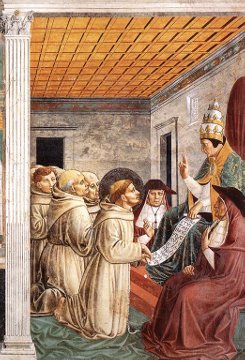
Special Today in Catholic History – St. Francis takes his vows

On April 16, Franciscans renew their vows in honor of St. Francis and his companions who made their vows into the hands of Pope Innocent III on this day in 1209.

According to the book Franciscans At Prayer, unfortunately out of print, the friars are to kneel in a circle around the altar after the celebration of Eucharist. They are to each carry a burning candle and pray for the help of the Holy Spirit. While they do this, the local minister is to encourage them to renew their profession and the Blessed Sacrament is exposed. In the name of all the friars, the local minister thanks God for the gift of being called to follow St. Francis, asks forgiveness for any sins against the Rule, repeats the vows of his solemn profession and then asks for the grace to persevere in the Rule until death.

This form as expressed in the Rituale Romano-Seraphicum in 1955 has been modified by various communities today but still contains these essential elements of renewal of vows, the importance of the Eucharist, and the emphasis on the community life. It should be noted that this renewal is intended as a devotional and has no juridical value. The renewal of vows is intended for Franciscans to recommit themselves to what they have already vowed to God that they would do.

Brothers, it has been a tradition in our Order that each year on April 16 – the day on which Francis made his profession into the hands of Pope Innocent III – we gather and renew our profession. The purpose of this renewal is to recall the origins of our Rule, to recall the devotion of Francis and his companions as they promised to follow the holy Gospel, to recall our own fervor as we begin this way of life, and to resolve to commit ourselves again to these ideals. Let us pray that with the help of God and the intercession of the Blessed Virgin Mary and St. Francis, we may regain our initial fervor and re-commit ourselves to the life we have professed – from Franciscans at Prayer

Today in Catholic History – Archbishop of New Orleans excommunicates three

On 16 April 1962 Archbishop Joseph Rummel of New Orleans excommunicated three Catholics for their public opposition to his plan to desegregate Archdiocesan schools.

New Orleans’ parishes and schools of the Archdiocese had been segregated since the failure of Reconstruction in the 1870s. Earlier Archbishops had sought to improve educational opportunities for black Catholics by establishing separate schools, but these schools were generally not as well funded or supported as the schools attended by white Catholics.

In 1948, Rummel admitted two black students to the Notre Dame Seminary. In 1951, he removed “white” and “colored” signs from the Catholic Churches and opened Saint Augustine High School – the first high school dedicated to the education of young black men. In 1953, he officially ordered the desegregation of the entire archdiocese. He wrote:

Ever mindful, therefore, of the basic truth that our Colored Catholic brethren share with us the same spiritual life and destiny, the same membership in the Mystical Body of Christ, the same dependence upon the Word of God, the participation in the Sacraments, especially the Most Holy Eucharist, the same need of moral and social encouragement, let there be no further discrimination or segregation in the pews, at the Communion rail, at the confessional and in parish meetings, just as there will be no segregation in the kingdom of heaven.

In 1956 he issued another pastoral letter proclaiming segregation incompatible with the teachings of the Catholic Church.

Desegregation faced a significant amount of opposition. One parish was ordered closed in 1955 when it refused to accept a black priest. Some Catholics sent a letter to Pope Pius XII seeking a papal decree in support of segregation, but Pius XII responded by declaring racism to be a major evil. Opposition to desegregation throughout Louisiana would delay school desegregation until the 1962-1963 school year.

In response to desegregation, there were public protests and threats to transfer children to segregated public schools. Archbishop Rummel threatened opponents with excommunication which caused most to accede to segregation but he would excommunicate three particularly vocal opponents for defying his authority. Again, opponents of desegregation sought support from the Vatican, but L’Osservatore Romano called Rummel’s actions “admirable”.

Eventually desegregation would be accepted throughout the archdiocese.

See Time Magazine articles on the subject
See article on one of the excommunicated

Today in Catholic History – Communium Interpretes Dolorum

On 15 April 1945, as WWII was coming to an and and on the same day the US army liberated the concentration camp at Colditz and the British and Canadian army liberated the concentration camp at Bergen-Belsen, Pope Pius XII issued his encyclical Communium Interpretes calling for the promotion of peace throughout the world.

In the encyclical, Pius XII reflected on the destruction caused by the war and called on the faithful to offer prayers to the Mother of God, especially in May – that month dedicated to her, that Christ might bring healing to all those who were suffering. In addition to the offering of prayers, the Pope called for a return to Christian morality and the renewal of public and private life. For, Pius XII warned that if true justice was not the goal then the world ran the risk of future wars.

The Pope specifically called for prayers for those who had been driven from their homes by the war and those who were imprisoned. Thus the encyclical served as an important document for the development of Catholic social teaching regarding the importance of peace and the care of refugees.

It is interesting to note that this was Pius XII’s first encyclical on the war, even though fighting had been raging throughout Europe ever since September 1 of 1939.

Communium Interpretes Dolorum

Today in Catholic History – The Baptism of Poland

On 14 April 966, Mieszko I – the first historical ruler of Poland, was baptized. This was followed by the baptism of the Polish people and the Christianization of that land. Where this baptism took place is a matter of historical debate, with Gniezno, Poznań, Ostrów Lednicki, Cologne, Regensburg and Rome being suggested.

Mieszko saw in Catholicism a way of uniting the Polish people in a common faith and of supporting his authority over Poland. Moreover, adopting Christianity gave it some protection against the strong German Holy Roman Empire on its borders which could have used Christianization as a motivation for attacking the Poles and putting them under its control. Other motivations suggested for the decision to be baptized are a desire to improve relations with the Czech kingdom of Bohemia to which his wife Dobrova belonged or a desire to weaken the powerful pagan priests.

Of course, since Poland chose to adopt Catholicism as a result of Czech missionaries from the West as opposed to its neighbor Russia which took the faith from the East, this will have profound effects on the future relations between these two peoples and the understanding of Slavic nationalism – these Czech missionaries had accompanied Dobrava when she married Mieszko in 965. Thus, Poland will adopt Latin liturgical traditions and the Latin alphabet whereas Russia will adopt the Slavonic alphabet and the liturgical traditions of Constantinople.

The baptism of Mieszko also may have had an influence on the Polish celebration of Dyngus Day. By tradition Mieszko was baptized on Easter Monday and the dousing of young women with water on Dyngus Day, celebrated on Easter Monday, may be related to this event.

For more on Mieszko and his baptism.

Catholic History in Other Podcasts

History According to Bob is doing a series of podcasts on Caterina Sforza, who had friendly relations with Pope Sixtus IV and not so friendly relations with Pope Alexander VI.

Stuff You Missed In History Class has done a recent episode on Michelangelo.

Today in Catholic History – Edict of Nantes

On 13 April 1598, Henry IV of France issued the Edict of Nantes which granted the Huguenots [French Calvinists] the right to public worship in certain French cities and ended the French Wars of Religion [1562-1598]. It was one one of the earliest decrees instituting religious toleration in Modern Europe.

Henry IV himself had been a Huguenot before becoming king and had converted to Catholicism because it had been required for him to take the French throne – supposedly saying “Paris is worth a Mass”.

Because Henry IV’s ability to protect Protestants against Catholics, who continued to desire religious uniformity in France, was limited the right to public worship granted by the Edict was restricted to specific “places of safety”. In addition to granting right to worship and full civil rights, the Edict also protected French Protestants from the Inquisition. Catholicism was retained as the established religion of France and Protestants still had to pay the Church tithe and respect Catholic holidays.

After the death of Henry IV, the tolerance offered to the Protestants in France would diminish until in October 1685, when Louis XIV revoked the Edict of Nantes and declared Protestantism illegal with the Edict of Fontainebleau. As a result as many as 400,000 Protestants left France. Since these were from France’s merchant class, this would have a devastating effect on the French economy.

For more on the Edict of Nantes

Today in Catholic History – The Fourth Crusade Captures Constantinople

On 12 April 1204, the Crusaders of the Fourth Crusade captured Constantinople, the capital of the Byzantine Empire and would establish the short lived Latin Empire which lasted until 1261.

The crusaders had sailed from Venice on 24 June 1202 with the intent to attack Cairo. They had been explicitly banned by Pope Innocent III from attacking any Christian states. However, when the crusaders began assembling, they had requested from Venice far more ships to be constructed than they would eventually need. Venice built ships for 33,500 crusaders but when the crusade set sail there were only 12,000 soldiers. Despite not needing the additional boats, Venice required that the crusaders pay for all ships constructed. This reduced many of the crusaders to poverty and placed a severe economic strain on the Venetians. When Byzantine prince Alexius Angelus approached the Crusaders with an offer to provide them with money, men and ships in exchange for helping him to overthrow Emperor Alexius III and restore Isaac II, the father of Prince Alexis, to the throne – the Crusaders saw an opportunity to recoup their losses.

While the initial motive of the crusader attack on Constantinople was to restore Isaac II to the throne, after the Crusaders overthrew Alexius III, prince Alexius – now Alexius IV, was unable to deliver the promised wealth to the Crusaders. Moreover, Alexius IV became extremely unpopular in Constantinople and was eventually strangled to death and replaced by one of his courtiers who would become Alexius V. The Crusaders then demanded that Alexius V honor Alexius IV’s agreement, but Alexius V refused. Therefore, the Crusaders continued their attack on Constantinople to get they money they believed they were owed.

It should be noted that Pope Innocent III had sent explicit letters forbidding an attack on Constantinople but these letters were kept hidden by the clergy participating in the siege of Constantinople.

When the Crusaders finally took Constantinople, the destruction was enormous. Fires in the city would leave 15,000 homeless. The sack of the city lasted three days, during which the Crusaders violated churches and destroyed the Library of Constantinople. One account writes:

the French and others destroyed indiscriminately, halting to refresh themselves with wine, violation of nuns, and murder of Orthodox clerics. The Crusaders vented their hatred for the Greeks most spectacularly in the desecration of the greatest Church in Christendom. They smashed the silver iconostasis, the icons and the holy books of Hagia Sophia, and seated upon the patriarchal throne a whore who sang coarse songs as they drank wine from the Church’s holy vessels… The Greeks were convinced that even the Turks, had they taken the city, would not have been as cruel as the Latin Christians.

When Pope Innocent III heard about what the Crusaders had done, he was furious and asked:

How, indeed, will the church of the Greeks, no matter how severely she is beset with afflictions and persecutions, return into ecclesiastical union and to a devotion for the Apostolic See, when she has seen in the Latins only an example of perdition and the works of darkness, so that she now, and with reason, detests the Latins more than dogs? As for those who were supposed to be seeking the ends of Jesus Christ, not their own ends, who made their swords, which they were supposed to use against the pagans, drip with Christian blood, they have spared neither religion, nor age, nor sex. They have committed incest, adultery, and fornication before the eyes of men. They have exposed both matrons and virgins, even those dedicated to God, to the sordid lusts of boys.

Although the Byzantines would eventually recover Constantinople, the Empire was permanently weakened and the destruction of the Fourth Crusade would contribute to the eventual fall of the Empire in 1453. Furthermore, while the schism between East and West could be said to have begun in 1054, it was the sack of Constantinople that made that rupture permanent.

The memory of the sack of Constantinople is still strong among the Orthodox. Twice, Pope John Paul II issued an apology for what the Catholic West had done. In April 2004, Orthodox Ecumenical Patriarch Bartholomew I formally accepted Pope John Paul II’s apology.

For more on the Fourth Crusade

#229 – A Message for the Khan

In just a few days, the Mongol armies had devastated the armies of Western Europe and all of Christendom seemed ready to fall. Pope Innocent IV placed all his hopes for peace in the hands of a sixty-five year old Franciscan.

Links:
Letter of Pope Innocent IV to the Great Khan
The Letter of Great Khan Güyük to Pope Innocent IV
The Journal of Father John de Plano Carpini

Photo is map of the journey of Father John de Plano Carpini

Be sure to check out the CUTH blog for more on the history of the Catholic Church

Send e-mail questions and comments to catholicunderthehood@gmail.com or leave voice mail at 1 740 936 4354

To listen, just click on the link below:

podcasticon#229 – A Message for the Khan

Today in Catholic History – Pope Paul VI establishes the International Theological Commission

On 11 April 1969, Pope Paul VI established the International Theological Commission [ITC]. The Commission is a dicastery/department of the Roman Curia, It consists of thirty Catholic scholars chosen from a wide variety of national backgrounds and theological specializations. Members are chosen by the Pope in consultation with the Congregation for the Doctrine of the Faith [CDF] and episcopal conferences. Each member serves a five year term, but can be reappointed. Generally, the ITC meets once a year for a week, usually in the Fall, to discuss a topic suggested by the Holy Father or one of their own choosing. The ex officio president of the ITC is the Prefect of the CDF. Pope John Paul II established the definitive statues for the ITC in the moto proprio Tredecim Anni on 6 August 1982.

The purpose of the ITC is to advise the CDF on issues of dogmatic importance and to bring together scholarly and pastoral opinion. The ITC has issued documents related to liberation theology, the relationship of Catholicism to other religions, Limbo, and evolution. It should be noted that the ITC is an advisory commission and its documents are not considered official or authoritative expressions of Catholic teaching.

Some of the members of the ITC have been Cardinal Joseph Ratzinger, Cardinal William Levada, and Cardinal Avery Dulles. In 2004, Pope John Paul II appointed the first two women to the ITC – Sara Butler, M.S.B.T. and Barbara Hallensleben.

Website of the ITC