Today in Catholic History – Clement XIV creates eleven cardinals in pectore

On 26 April 1773, Pope Clement XIV created as many as eleven cardinals in pectore or in the breast. None of the names of these cardinals was ever published. Though there is some speculation that Hyacinthe Cardinal Sigismond Gerdil, C.R.S.P. who would later be named a cardinal under Pope Pius VI was one of them.

The first Pope to appoint a cardinal in pectore was Pope Paul III. Other popes would follow this example throughout history. Pope John Paul II. A pope would chose to create a cardinal in pectore or secret if he believed that publicly naming the cardinal would threaten the cardinal’s life or the faithful in the country where the cardinal lived. For example, in the 20th century popes would create cardinals in Eastern Europe in pectore out of concern over a hostile communist response.

A cardinal created in pectore has no rights as a cardinal until his name has been publicly published and if the pope who named him cardinal dies before having declared their name their status as a cardinal comes to an end as well. However, when a cardinal created in pectore is named, his seniority in the College of Cardinals is dated from the time when he had been created in pectore, not from the time he was publicly named.

For more on in pectore cardinals

Today in Catholic History – The Second Diet of Speyer and the beginnings of Protestantism

On 25 April 1529, Lutheran representatives at the Second Diet of Speyer issued a letter of protest against the decisions of the Diet’s Roman Catholic majority to enforce the Edict of Worms and prohibit further reformation in the Holy Roman Empire.

The purpose of the Second Diet of Speyer, which began on 15 March 1529, was to coordinate the response of the German princes and other leaders of the Holy Roman Empire against the threat of the Turks and address the issue of division in the Empire brought about by the ideas of Martin Luther and Heinrich Zwingli.

Attendees of the Diet who supported the Catholic Church wanted to reverse the earlier policy of religious tolerance adopted in 1526 at the First Diet of Speyer. This Diet had permitted “each one to live, govern and carry himself as he hopes to answer it to God and His Imperial Majesty.” Reversing the decisions of the First Diet was also the desire of Archduke Ferdinand, who led the Diet in the name of his brother the Holy Roman Emperor Charles V. Ferdinand ordered that all of the states of the Holy Roman Empire were to tolerate the practice of Catholicism, but Lutheranism would only be tolerated in those German states which had already done so – not in any additional states. Any further attempt to institute Lutheranism would be prohibited. Followers of Zwingli and the Anabaptists would not be tolerated at all. Indeed Anabaptists were to be put to death.

In response, the Lutheran attendees of the Diet issued a legal appeal on behalf of themselves, their subjects and all Christians. This appeal was a protest against those decisions of the Second Diet which they deemed contrary to the Word of God, their consciences and the earlier decisions of the First Diet of Speyer. It was signed by six German princes and representatives of fourteen Imperial Free Cities.

This protest would result in the term “Protestant” to be applied first of all to Lutherans and then to all non-Catholic and non-Orthodox Christians.

More on the Second Diet of Speyer

Today in Catholic History – The Armenian Genocide

On 24 April 1915, 250 Armenian intellectuals and community leaders were arrested in Constantinople/Istanbul marking the beginning of the Armenian genocide that would eventually take the lives of one and a half million people. Another one half million would flee Turkey.

The Young Turk government that replaced the Ottoman Empire at the end of WWI sought to eliminate any non-Turkish elements of the population. The large Armenian population – which at that time numbered around two million was a major obstacle to the goals of the new government.

While the brunt of the genocide fell upon the Armenian Apostolic Church, the Armenian Catholics would see 19 eparchies, 156 churches and chapels, 110 missions, 148 schools, 32 monasteries and convents and six seminaries destroyed. 7 bishops, 130 priests and 47 nuns and as many as 100,000 Armenian Catholics died, including Blessed Ignatius Maloyan. Most Armenian Catholics would flee Turkey for Lebanon and Syria. The Armenian Catholic Patriarchate would be transferred to Bzoummar, Lebanon.

The Martyrdom of Blessed Bishop Ignatius Maloyan:

On June 3, 1915, Turkish soldiers dragged Bishop Maloyan in chains to court with twenty seven other Armenian Catholic personalities. The next day, twenty five priests and eight hundred and sixty two believers were held in chains. During trial, the chief of the police, Mamdooh Bek, asked the Bishop to convert to Islam. The bishop answered that he would never betray Christ and His Church. The good shepherd told him that he was ready to suffer all kinds of ill-treatments and even death and in this will be his happiness.

Mamdooh Bek hit him on the head with the rear of his pistol and ordered to put him in jail. The soldiers chained his feet and hands, threw him on the ground and hit him mercilessly. With each blow, the Bishop was heard saying “Oh Lord, have mercy on me, oh Lord, give me strength”, and asked the priests present for absolution. With that, the soldiers went back to hitting him and they extracted his toe nails.

On June 9, his mother visited him and cried for his state. But the valiant Bishop encouraged her. On the next day, the soldiers gathered four hundred and forty seven Armenians. The soldiers along with the convoys took the desert route.

The bishop encouraged his parishioners to remain firm in their faith. Then all knelt with him. He prayed to God that they accept martyrdom with patience and courage. The priests granted the believers absolution. The Bishop took out a piece of bread, blessed it, recited the words of the Eucharist and gave it to his priests to distribute among the people.

One of the soldiers, an eye witness, recounted this scene: “That hour, I saw a cloud covering the prisoners and from all emitted a perfumed scent. There was a look of joy and serenity on their faces”. As they were all going to die out of love for Jesus. After a two-hour walk, hungry, naked and chained, the soldiers attacked the prisoners and killed them before the Bishop’s eyes. After the massacre of the two convoys came the turn of Bishop Maloyan.

Mamdooh Bek then asked Maloyan again to convert to Islam. The soldier of Christ answered: “I’ve told you I shall live and die for the sake of my faith and religion. I take pride in the Cross of my God and Lord”. Mamdooh got very angry, he drew his pistol and shot Maloyan. Before he breathed his last breath he cried out loud: “My God, have mercy on me; into your hands I commend my spirit”.

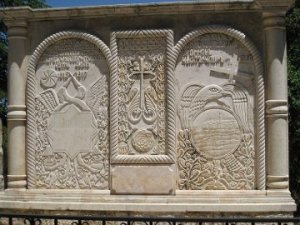
Photo of the Memorial to the Armenian Genocide at the Armenian Catholic Patriarchate by Serouj
Armenian Genocide Museum
Armenian Catholic Church

Today in Catholic History – Catholic Knights of America hold first meeting

On 23 April 1877, the Catholic Knights of America held its first meeting in Nashville, Tennessee. The Knights were formed as a fraternal-life insurance company and to offer the benefits of a fraternal organization to Catholics.

The objective of the organization was to, “promote friendship, unity, and true Christian charity among its members; friendship in assisting each other by every honorable means; unity, in associating together for mutual support of one another when sick or in distress, and in making suitable provision for widows, orphans and dependents of deceased members; true Christian charity, in doing unto each other as we would have others do unto us.”

Originally the organization was to be named the Order of the United Catholics, but was later changed based upon a suggestion of Bishop P. A. Feehan of Nashville. Feehan also served as the Knights first spiritual director. Later branches of the Catholic Knights of America were formed in West Virginia, Kentucky, Indiana and Ohio. Eventually, the Knights had branches in every state.

In 2005, the Catholic Knights of America merged with a different organization, the Catholic Knights of Milwaukee.

Website of the Catholic Knights

Today in Catholic History – Fr. Walter Ciszek, SJ finishes fifteen year sentence in Soviet Union

On 22 April 1955, Fr. Walter Ciszek, SJ finished his fifteen year sentence in the Soviet Union’s Gulag and was released to the city of Norilsk, though with restrictions on his movement. He was finally able to write to his sisters in the United States to inform them of his fate, until this time his family and the Jesuits believed him dead.

Fr. Ciszeck had come to the Soviet Union in 1940 disguised as a worker, but in 1941 he was arrested for spying for the Vatican. He spent five years in solitary confinement in one of the Soviet Union’s most notorious prisons before being sent to the GULAG. During his imprisonment, Fr. Ciszek would continue to act as a priest by hearing confessions, celebrating Mass and offering retreats.

He did not return to the United Sates until 1963 and would write an account of his experiences in the book “With God in Russia”.

The Father Walter Ciszek Prayer League

Today in Catholic History – Inscrutabili Dei Consilio

On Easter Sunday 21 April 1878, Pope Leo XIII issued the encyclical Inscrutabili Dei Consilio or On the Evils of Society. This was the first encyclical of his pontificate and stressed many of the themes which would guide his future papacy.

In this encyclical, Pope Leo identifies several threats facing humanity at his time, chiefly that the rejection of objective truth and authority which has led to civil strife and war; the rejection of law; and a desire for the things of this world rather than the eternal. The chief defense against these threats is the Catholic Church, which is why Pope Leo believes it is under attack.

Leo stresses the contributions of the Catholic Church to civilization through science and culture. He also calls for the restoration of Vatican political independence to ensure that the Church can freely exercise its responsibilities in the world.

Even though Pope Leo warns against the evils he perceives in society, he stresses that he wishes to work with the countries and peoples of the world for the advancement of the common good. Furthermore, he encourages the priests and bishops to continue striving to present the truth of the faith in union with the Pope and as expressed by “the great Augustine and the Angelic Doctor, with all other teachers of Christian wisdom…”

One area of particular importance for Leo XIII is the preservation of the sanctity of marriage. It is in the family that the foundation of a moral life begins. The decline of the family means the decline of civilization.

This encyclical really sets the foundation for Leo XIII’s papacy and his view that the problems of the modern world should be solved by the Catholic Church and the governments of the world working together rather than in opposition.

Inscrutabili Dei Consilio

Today in Catholic History – The Foundation of Sapienza – Università di Roma

On 20 April 1303, Pope Boniface VIII issued the bull In Supremae Praeminentia Dignitatis establishing the Studium Urbis, in 1660 to become known as as La Sapienza, or Wisdom, and today known as Sapienza – Università di Roma. Which today, although no longer under the control of the Pope, is the largest university in Europe and the oldest of the three public universities in Rome.

Pope Boniface founded the university for the purpose of ecclesiastical studies. The name La Sapienza came from the 111th Psalm – “the fear of the Lord is the beginning of wisdom”.

Pope Eugenius IV in October 1431 would issue a bull, In Supremae, which would establish additional funding for the university through a tax on wine. He also established the faculties of law, philosophy, medicine and theology.

In 1870, after the capture of Rome by the armies of the Kingdom of Italy, La Sapienza shifted from papal control to that of the government of Italy.

In January 2008, a hostile response from 67 professors of Sapienza and many students would cause Pope Benedict XVI to cancel a proposed lecture at the university.

More on Sapienza
Pope Benedict XVI’s proposed lecture at Sapienza and the controversy over it

Today in Catholic History – Establishment of the Pontifical Commission for Latin America

On 19 April 1958, Pope Pius XII established the Pontifical Commission for Latin America with the purpose of evaluating and assisting with issues related to the Catholic Church in Latin America. It operates under the Congregation of Bishops.

Pope John Paul II defined the present responsibilities of the Commission in Article 83 of the Apostolic Constitution on the Roman Curia, Pastor Bonus, as “to be available to the particular Churches in Latin America, by counsel and by action, taking a keen interest in the questions that affect the life and progress of those Churches; and especially to help the Churches themselves in the solution of those questions, or to be helpful to those dicasteries of the Curia that are involved by reason of their competence.”

Some of the topics in which the Commission has been involved are priestly formation in Latin America, evangelization, immigration, poverty and globalization. The president of the Commission is the Prefect of the Congregation of Bishops, presently this is Giovanni Cardinal Re.

Pontifical Commission for Latin America

#230 – Michelangelo, La Pietà and Laszlo Toth

On Pentecost Sunday 1972, Laszlo Toth took a hammer to the masterpiece of Michelangelo amidst a crowd of stunned visitors to St. Peter’s Basilica.

Links:
Video of the damage to La Pietà – again the audio is a little too apocalyptic, but the images are very moving
Articles on La Pietà
Michelangelo’s other Pietà – The Deposition or Florentine Pietà, the Rodanini Pietà and perhaps the Palestrina Pietà.

Be sure to check out the CUTH blog for more on the history of the Catholic Church

Send e-mail questions and comments to catholicunderthehood@gmail.com or leave voice mail at 1 740 936 4354

To listen, just click on the link below:

podcasticon#230 – Michelangelo, La Pietà and Laszlo Toth

Today in Catholic History – Cornerstone of current Saint Peter’s Basilica laid

On 18 April 1506, the cornerstone of the present Basilica of St. Peter in Vatican City was laid at the base of where the column of St. Veronica is now located.

The original St. Peter’s Basilica, built by Emperor Constantine in fourth century, had fallen into disrepair by the end of the 15th century. Therefore Nicholas V commissioned a plan for a new basilica from Bernardo Rossellino. But it was Pope Julius II who would make the decision to demolish the old basilica. Several architects would submit proposals to Pope Julius for the new St. Peter’s but it was Donato Bramante’s that was accepted.

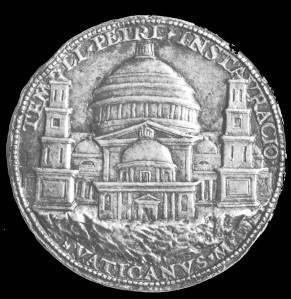
Present at the laying of the foundation stone were some of the major figures of the Renaissance; such as Cesare Borgia, Niccolò Machiavelli, and three future popes. The pit for the foundation stone was very deep and Julius II, at sixty-three years old, had to climb down into it. There was a fear that the ground might give way while the Pope was inside the pit and he warned others to not come too close. Inside the hole for the foundation stone – a block of marble “four palms wide, two broad, and three fingers thick” was placed an urn holding one dozen commemorative medals symbolizing the twelve apostles. Each medal had on one side an image of the pope and on the other a picture of the new church. The image on the medal was probably that of Bramante’s design – seen in the image accompanying this post.

The actual construction of St. Peter’s would take the next 120 years and several papacies, finally being completed on 18 November 1626. One method of financing the construction of the new basilica was through the selling of indulgences – this would later lead to the attacks of Martin Luther and the Protestant Reformation.

For more on St. Peter’s Basilica