Today in Catholic History – The Council of Basel

On 23 July 1431, the legate of Pope Eugene IV invoked the Council of Basel.

This council was originally called by Pope Martin V as required by the prior Ecumenical Council of Constance. Basel, Switzerland was chosen as the site of the council by the majority of participants who wished to continue the policy of Concilliarism which sought to place the authority of the council over that of the papacy. The Concilliarists wanted a site outside the Papal States, the Holy Roman Empire or France in order to avoid being unduly influenced by the rulers of those states.

From the beginning the council was in conflict between the Concilliarist who wished to limit the authority of the papacy and Pope Eugene who wished to reassert papal primacy. Eugene also believed that the council was not sufficiently dealing with the issue of the Hussites – those who followed John Hus, who had been burned at the stake at the previous council of Constance.

Attempting to take a firmer control over the Council, Eugene tried to disband it and move it to Bologna but was strongly opposed by the members of the Council of Basel and was eventually forced to withdraw his order for the councils dissolution.

The desire of Emperor John VIII Paleologus of the Byzantine Empire to have a council discussing the possibility of union between the Orthodox and Catholic Churches will give Pope Eugene his opportunity to put an end to Basel. While the attendees at Basel were willing to have such a council, they were unwilling to meet in Italy where the Emperor wished to meet. Pope Eugene will take advantage of this difference to offer Emperor John VIII a meeting location in Ferrara, Italy. The Emperor accepted and Pope Eugene declared the end of the Council of Basel on 18 September 1437 and its transfer to Ferrara. At the first session of Ferrara, all the previous decisions of the Council of Basel were declared null and void.

The majority of the attendees at Basel refused to accept the Pope’s actions and declared Pope Eugene deposed on 25 June 1439 and would elect an anti-pope Felix V. This would cause a schism in the Church which would last for ten years. In 1449, anti-pope Felix will abdicate and the remnants of the Council of Basel will dissolve themselves claiming that they believed that Pope Eugene’s successor Nicholas V accepted the superiority of the council over the papacy as defined at Constance and Basel.

Today in Catholic History – The Siege of Belgrade

On 22 July 1456, the forces of the Hungarian nobleman John Hunyadi defeated the armies of Ottoman Sultan Mehmet II forcing him to lift the Ottoman siege of Belgrade which had lasted since 4 July 1456.

Hunyadi forces consisted not only his own personal soldiers but also a large gathering of peasants who had flocked to Hunyadi’s banner after St. John of Capistrano had preached a crusade.

On 14 July 1456, Hunyadi arrived at Belgrade and managed to break the naval blockade the Ottomans had imposed on the city.

After managing to push back a major Ottoman attack, the peasants which had followed the banner of St. John of Capistrano spontaneously began a counter-attack on Mehmet’s army. St. John, finding himself surrounded by 2,000 crusaders eager to attack the Turks, led them toward the Ottomans while shouting, “The Lord who made the beginning will take care of the finish!” The Ottoman forces surprised by the crusader assault will break the siege and flee back to Constantinople.

During the siege, Pope Callixtus III had ordered that every Christian Church ring its bells every day at noon as a call for Christians to pray for the defenders of Belgrade. Since Christians in many countries in Western Europe did not hear of this command until after they received news that the Christian forces had been victorious, the ringing of the bells became understood as a sign of Christian victory. Pope Callixtus did not rescind his command and so the tradition of ringing the noon day bell in Catholic church began – a tradition which continues today.

#241 – The Formation of an Identity Part II

Surviving serious crisis and threats to its existence, the Uniate Church in the Polish Lithuanian Commonwealth comes to see itself as flower shining forth the “grandeur of the Church”.

Sources:
Barbara Skinner – The Western Front of the Eastern Church. Uniate and Orthodox Conflict in 18th-century Poland, Ukraine, Belarus, and Russia 2009
Joseph Macha, SJ – Ecclesiastical Unification. A Theoretical Framework Together With Case Studies From the History of Latin-Byzantine Relations 1974
Paul Magocsi – A History of Ukraine 1996
Serhii Plokhy – The Cossacks and Religion in Early Modern Ukraine 2001

Be sure to check out the CUTH blog for more on the history of the Catholic Church

Also check out the other great podcasts at the Starquest Production Network

Send e-mail questions and comments to catholicunderthehood@gmail.com or leave voice mail at 1 740 936 4354

To listen, just click on the link below:

podcasticon#241 – The Formation of an Identity Part II

Today in Catholic History – Exposcit Debitum

On 21 July 1550, Pope Julius III issued the Bull Exposcit Debitum [The Duty Requires] giving final approval to the foundation of the Society of Jesus/Jesuits. This document continues to be the defining text for the mission and charism of the Society of Jesus today.

The Bull clearly reflects the spirituality of the Jesuit as a “soldier of God” and “to strive especially for the defense and propagation of the faith”. Exposcit Debitum also expresses the particular obedience the Jesuit owes to the Holy Father as:

For the sake of greater devotion in obedience to the Apostolic See, of greater abnegation of our own wills and of surer direction from the Holy Spirit, we have nevertheless judged it to be supremely profitable that each of us and any others who will make the same profession in the future should, in addition to that ordinary bond of the three vows, be bound by this special vow to carry out whatever the present and future Roman Pontiffs may order which pertains to the progress of souls and the propagation of the faith; and to go at once, without subterfuge or excuse, as far as in us lies.

The language of the Bull reflect both St. Ignatius’ belief that the Protestant Reformation was a threat to the Catholic Church, thus the need to defend the faith, and Pope Julius’ understanding that the Jesuits would be instrumental in spreading the faith to non-Christian lands, thus the need to propagate the faith.

Today in Catholic History – The Foundation of the Sisters of St. Francis of Perpetual Adoration

On 20 July 1863, Mother Maria Theresia Bonzel established the congregation of the Sisters of St. Francis of Perpetual Adoration in Olpe, Germany.

This Third Order congregation sought to connect Mother Maria’s devotion to St. Francis of Assisi and Eucharistic Adoration with a real need to provide education to orphans and homeless children and to minister to the sick and wounded. Her motto was “He leads, I follow.”

In 1875, six of the sisters will emigrate to Lafayette, Indiana in response to the persecutions of the German Kulturkampf. In 1876, they will establish St. Elizabeth’s hospital. In 1886, the community will be divided into German and American provinces – the American province would later be divided into Eastern and Western provinces. A province in the Philippines has also been established.

When Mother Maria died on 6 February 1905, there were more than 1,500 sisters in her congregation.

Today, the sisters continue to minister in health care and education.

On 20 March 2010, Pope Benedict XVI declared Mother Maria Venerable.

Sisters of Saint Francis of Perpetual Adoration

Today in Catholic History – The Bombing of the Basilica di San Lorenzo fuori le Mura

On 19th July 1943, between 11 a.m. and 12 noon, 150 Allied B-17 bombers attacked a freight yard and steel factory in Rome near the Basilica di San Lorenzo fuori le Mura [Saint Lawrence Outside The Walls]. During the attack bombs fell upon the Basilica causing major damage and killing and injuring more than one thousand civilians.

Pope Pius XII had been deeply concerned about the threat war posed to Rome and the likelihood Rome might be a major target. The Allied forces first bombed Rome on 16th of May 1943, leading the Pope to ask US President Franklin Roosevelt that Rome “be spared as far as possible further pain and devastation, and their many treasured shrines… from irreparable ruin.” Roosevelt promised that Allied planes were instructed to avoid bombing Vatican City and that neither civilian nor non-military sites wold be targeted. The US command wanted to pay particular attention to preserving the safety of Catholic places because of the large number of Catholics in the US Armed Forces.

The Allied bombers had not intended to damage the basilica. Indeed, the Allied commanders had specifically ordered in regards to the Vatican, the Basilica of Saint John Lateran and the Basilica of Saint Paul Outside the Walls that they “must on no account be damaged.” Before the bombing, Allied planes dropped leaflets explaining that no attempt was being made to bomb “those cultural monuments which are the glory not only of Rome but of the civilized world.” However, some of the Allied bombs fell short of their intended targets and struck San Lorenzo.

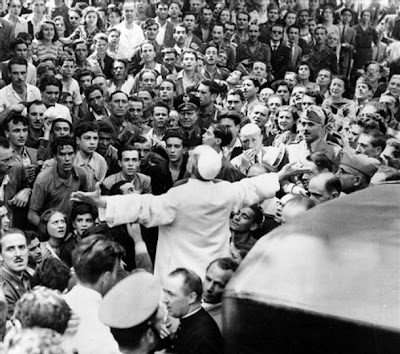
Immediately after the bombing of the Basilica di San Lorenzo, Pius XII and Msgr. Giovanni Batista Montini [the future Paul VI] went to the basilica and distributed ₤ 2 million to the victims. Those who were there on that day would remember how the white cassock of the Pope would be stained red with the blood of the victims.

On 20 July 1943, Pius XII sent an angry message to President Roosevelt in which he said, “As Bishop of this Sacred city we have constantly tried to save our beloved Rome from devastation…But this reasonable hope has, alas, been frustrated.” Several US Bishops sympathized with this response.

However, some US Bishops, such as Bishop Joseph Lynch of Dallas and Edwin O’Hara of Kansas City, defended the bombing on the grounds that the Basilica had not been deliberately targeted and that such attacks were necessary to overcome the evil of the Axis powers. American Catholics would also blame Mussolini for not declaring Rome an open city which would have protected it from Allied attack.

The Basilica di San Lorenzo would be restored in 1948. During the restoration many of the changes to the church which were made during Pius IX’s 19th century restoration were removed.

E il Papa la domenica mattina da San Pietro,
uscì tutto da solo tra la gente, e in mezzo a San Lorenzo,
spalancò le ali, sembrava proprio un angelo con gli occhiali.

[And the Pope that Sunday morning at San Pietro,
went out alone among the people, and in the middle of San Lorenzo
he spread his wings, he looked like an angel with glasses.]
Francesco De Gregori – San Lorenzo

A very interesting collection of photos of the Basilica di San Lorenzo and how it looked before the bombing, after the bombing and how it looks today
An image of Pius XII at San Lorenzo after the bombing

Today in Catholic History – Pastor Aeternus and Papal Infalibility

On 18 July 1870, Pastor Aeternus or the Dogmatic Constitution of the Church of Christ was approved by the First Vatican Council.

Pastor Aeternus was intended to emphasize the power and authority of the papacy in the face of political, social, and religious threats present in Europe and the world at the time. To emphasize that the Papacy could be relied upon as the source of truth in an environment in which the very notion of absolute truth that could be known was being called into question.

Thus, Pastor Aeternus, stresses that the primacy of the Pope comes from divine authority of and was instituted by Jesus Christ and that the authority of the Pope presides over the entire Church. One of the most important aspects of Papal authority is exercised in the Pope’s teaching authority, the

We teach and define that it is a dogma Divinely revealed that the Roman pontiff when he speaks ex cathedra, that is when in discharge of the office of pastor and doctor of all Christians, by virtue of his supreme Apostolic authority, he defines a doctrine regarding faith or morals to be held by the universal Church, by the Divine assistance promised to him in Blessed Peter, is possessed of that infallibility with which the Divine Redeemer willed that his Church should be endowed in defining doctrine regarding faith or morals, and that therefore such definitions of the Roman pontiff are of themselves and not from the consent of the Church irreformable.

So then, should anyone, which God forbid, have the temerity to reject this definition of ours: let him be anathema.

This declaration of Papal Infallibility was indeed controversial, even among the bishops present at the First Vatican Council. Many bishops who accepted Papal Infallibility still believed that the tense situation and likely negative response by secular society suggested that it would be imprudent to issue Pastor Aeternus at this time. This was a particular concern of the Bishops of the United States, France, and Germany. Indeed 60 bishops abstained from the vote on Pastor Aeternus by leaving Rome for their home countries on the day the vote was taken.

However, the large majority of bishops supported Pastor Aeternus and all of those who abstained did voice their acceptance of the document after it was confirmed at the First Vatican Council.

Negative reaction amongst some Catholics in Switzerland, Austria and Germany will lead to the formation of the Old Catholic Church. German Chancellor Otto von Bismark will begin his policy of persecution directed against the Catholic Church, the Kulturkampf, in response to Pastor Aeternus, arguing that German Catholic obedience to the papacy meant that they were not fully loyal to the German Kaiser.

Pastor Aeternus

Today in Catholic History – The Martyrdom of Alexei Trupp

On 17 July 1918, Tsar Nicholas II of Russia and his family were murdered by the Bolsheviks. While Nicholas and his family were Orthodox, their footman Alexei Trupp, who was also murdered at this time, was Roman Catholic.

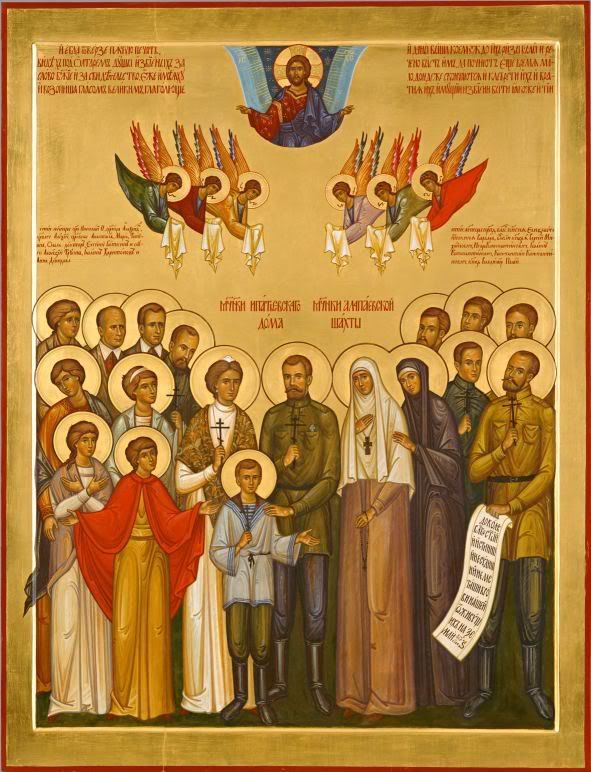
In 1981, the Russian Church Outside Russia [ROCOR] declared Nicholas II, his family and his servants who were killed by the Bolsheviks on the 17th of July to be martyrs – this would include Alexei Trupp.

The Russian Orthodox Church did not recognize the murdered Royal family as martyrs, instead it considers them to be Passion Bearers – people who lived a virtuous life but did not die for the faith. The Russian Orthodox Church also did not consider Alexei Trupp to be a martyr since he died a member of the Catholic Church. However, it does consider their faithful service to Nicholas and his family to be worthy of remembrance in the published lives of the Holy Passion Bearers.

Thus the now united ROCOR/Russian Orthodox Church does not include Alexei Trupp amongst its recognized saints.

Image of Alexei Trupp
Image of Icon of Holy Russian New Martyrs done for a ROCOR church including and image of St. Alexei Trupp [in middle of top left row]

Today in Catholic History – The Start of the East-West Schism

On 16 July 1054, the emissaries of Pope Leo IX led by Cardinal Humbert of Mourmoutiers entered the Basilica of the Hagia Sophia in Constantinople during the celebration of the Divine Liturgy and placed a bull of excommunication against the Patriarch of Constantinople Michael Cerularius atop the altar. The priests of Constantinople chased after the legates, begging them to take back the bull of excommunication in vain. Thus initiating the present split between the Catholic and Orthodox Churches was begun.

The immediate source of the conflict was the practice of the Normans in southern Italy of forcing the Greeks to adopt Latin practices. In response Patriarch Cerularius had forced Latin churches in Constantinople to adopt Greek practices. Cardinal Humbert was sent to Constantinople in order to deal with this conflict.

While Humbert had been sent to to Constantinople to deal with the conflict over ritual differences between East and West – such as use of unleavened bread in the West in the Eucharist; the poor treatment of the legates was what truly led him to issue this bull of excommunication accusing the Patriarch of simony, rebaptizing Latins, allowing priests to marry, baptizing women in labor, abandoning the Mosaic law, refusing communion to men who had shaven their beards and omitting the filioque clause in the Creed.

In many of these accusations Humbert was incorrect and and ignorant of Eastern practice; moreover, Pope Leo had died some time prior to this event, therefore Humbert also did not have the proper authority to issue this excommunication. His status as papal legate came to an end with the death of the pope who appointed him.

After the legates left Constantinople, the bull of excommunication was burnt and the Church in Constantinople excommunicated Humbert and the other papal legates but did not excommunicate the pope.

However, it was Humbert’s version of events which would color the West’s image of the East and keep the schism alive. The West, believing that it held primacy over the entire Church, wanted the East to acknowledge its errors, the East did not believe that any errors had been made and refused to recognize the West’s understanding of papal authority.

While most historians place this date as the beginnings of the split between East and West, it would be the Crusader Sack of Constantinople in 1204 which would make this split permanent.

On 7 December 1965, Pope Paul VI and Ecumenical Patriarch Athenagoras lifted these mutual excommunications.

Today in Catholic History – Basilica of St. Paul’s Outside the Walls Almost Destroyed By Fire

On 15 July 1823, the Basilica of St. Paul’s Outside the Walls was almost destroyed by fire.

The basilica, one of the five major basilicas of Rome, was originally built by Constantine I atop the site of the execution of Saint Paul, but was modified throughout its long history. From 1215-1964, it was the see of the Latin Patriarch of Alexandria.

The fire was apparently caused by worker negligence during repair of the roof. Workers were soldering the lead roof when burning coals from from a brazier used to melt the solder fell on the roof. Most of the basilica was destroyed including almost all of the paintings of the pontiffs which lined the basilica’s walls.

The Basilica would be repaired and reconsecrated in 1855 by Pope Pius IX and fifty cardinals whose names can be seen inside the basilica. Many countries would send materials for the reconstruction, including the Emperor of Russia Nicholas I who sent malachite and lapis lazuli for the tabernacle. So, while most of what can be seen at the Basilica today is modern but the repairs did attempt to use original materials and the original design of the basilica.

A print of the fire damaged basilica can be found here.