Category Archives: Papal History

Today in Catholic History – The Foundation of Sapienza – Università di Roma

On 20 April 1303, Pope Boniface VIII issued the bull In Supremae Praeminentia Dignitatis establishing the Studium Urbis, in 1660 to become known as as La Sapienza, or Wisdom, and today known as Sapienza – Università di Roma. Which today, although no longer under the control of the Pope, is the largest university in Europe and the oldest of the three public universities in Rome.

Pope Boniface founded the university for the purpose of ecclesiastical studies. The name La Sapienza came from the 111th Psalm – “the fear of the Lord is the beginning of wisdom”.

Pope Eugenius IV in October 1431 would issue a bull, In Supremae, which would establish additional funding for the university through a tax on wine. He also established the faculties of law, philosophy, medicine and theology.

In 1870, after the capture of Rome by the armies of the Kingdom of Italy, La Sapienza shifted from papal control to that of the government of Italy.

In January 2008, a hostile response from 67 professors of Sapienza and many students would cause Pope Benedict XVI to cancel a proposed lecture at the university.

More on Sapienza
Pope Benedict XVI’s proposed lecture at Sapienza and the controversy over it

Today in Catholic History – Establishment of the Pontifical Commission for Latin America

On 19 April 1958, Pope Pius XII established the Pontifical Commission for Latin America with the purpose of evaluating and assisting with issues related to the Catholic Church in Latin America. It operates under the Congregation of Bishops.

Pope John Paul II defined the present responsibilities of the Commission in Article 83 of the Apostolic Constitution on the Roman Curia, Pastor Bonus, as “to be available to the particular Churches in Latin America, by counsel and by action, taking a keen interest in the questions that affect the life and progress of those Churches; and especially to help the Churches themselves in the solution of those questions, or to be helpful to those dicasteries of the Curia that are involved by reason of their competence.”

Some of the topics in which the Commission has been involved are priestly formation in Latin America, evangelization, immigration, poverty and globalization. The president of the Commission is the Prefect of the Congregation of Bishops, presently this is Giovanni Cardinal Re.

Pontifical Commission for Latin America

#230 – Michelangelo, La Pietà and Laszlo Toth

On Pentecost Sunday 1972, Laszlo Toth took a hammer to the masterpiece of Michelangelo amidst a crowd of stunned visitors to St. Peter’s Basilica.

Links:
Video of the damage to La Pietà – again the audio is a little too apocalyptic, but the images are very moving
Articles on La Pietà
Michelangelo’s other Pietà – The Deposition or Florentine Pietà, the Rodanini Pietà and perhaps the Palestrina Pietà.

Be sure to check out the CUTH blog for more on the history of the Catholic Church

Send e-mail questions and comments to catholicunderthehood@gmail.com or leave voice mail at 1 740 936 4354

To listen, just click on the link below:

podcasticon#230 – Michelangelo, La Pietà and Laszlo Toth

Today in Catholic History – Cornerstone of current Saint Peter’s Basilica laid

On 18 April 1506, the cornerstone of the present Basilica of St. Peter in Vatican City was laid at the base of where the column of St. Veronica is now located.

The original St. Peter’s Basilica, built by Emperor Constantine in fourth century, had fallen into disrepair by the end of the 15th century. Therefore Nicholas V commissioned a plan for a new basilica from Bernardo Rossellino. But it was Pope Julius II who would make the decision to demolish the old basilica. Several architects would submit proposals to Pope Julius for the new St. Peter’s but it was Donato Bramante’s that was accepted.

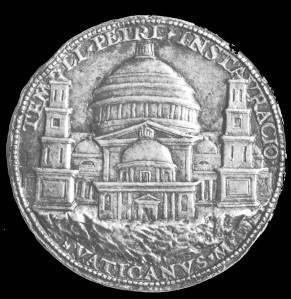
Present at the laying of the foundation stone were some of the major figures of the Renaissance; such as Cesare Borgia, Niccolò Machiavelli, and three future popes. The pit for the foundation stone was very deep and Julius II, at sixty-three years old, had to climb down into it. There was a fear that the ground might give way while the Pope was inside the pit and he warned others to not come too close. Inside the hole for the foundation stone – a block of marble “four palms wide, two broad, and three fingers thick” was placed an urn holding one dozen commemorative medals symbolizing the twelve apostles. Each medal had on one side an image of the pope and on the other a picture of the new church. The image on the medal was probably that of Bramante’s design – seen in the image accompanying this post.

The actual construction of St. Peter’s would take the next 120 years and several papacies, finally being completed on 18 November 1626. One method of financing the construction of the new basilica was through the selling of indulgences – this would later lead to the attacks of Martin Luther and the Protestant Reformation.

For more on St. Peter’s Basilica

Special Today in Catholic History – St. Francis takes his vows

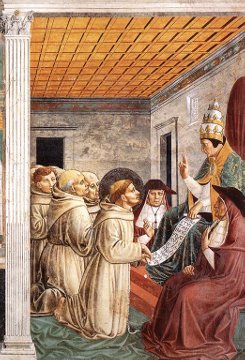
On April 16, Franciscans renew their vows in honor of St. Francis and his companions who made their vows into the hands of Pope Innocent III on this day in 1209.

According to the book Franciscans At Prayer, unfortunately out of print, the friars are to kneel in a circle around the altar after the celebration of Eucharist. They are to each carry a burning candle and pray for the help of the Holy Spirit. While they do this, the local minister is to encourage them to renew their profession and the Blessed Sacrament is exposed. In the name of all the friars, the local minister thanks God for the gift of being called to follow St. Francis, asks forgiveness for any sins against the Rule, repeats the vows of his solemn profession and then asks for the grace to persevere in the Rule until death.

This form as expressed in the Rituale Romano-Seraphicum in 1955 has been modified by various communities today but still contains these essential elements of renewal of vows, the importance of the Eucharist, and the emphasis on the community life. It should be noted that this renewal is intended as a devotional and has no juridical value. The renewal of vows is intended for Franciscans to recommit themselves to what they have already vowed to God that they would do.

Brothers, it has been a tradition in our Order that each year on April 16 – the day on which Francis made his profession into the hands of Pope Innocent III – we gather and renew our profession. The purpose of this renewal is to recall the origins of our Rule, to recall the devotion of Francis and his companions as they promised to follow the holy Gospel, to recall our own fervor as we begin this way of life, and to resolve to commit ourselves again to these ideals. Let us pray that with the help of God and the intercession of the Blessed Virgin Mary and St. Francis, we may regain our initial fervor and re-commit ourselves to the life we have professed – from Franciscans at Prayer

Today in Catholic History – Communium Interpretes Dolorum

On 15 April 1945, as WWII was coming to an and and on the same day the US army liberated the concentration camp at Colditz and the British and Canadian army liberated the concentration camp at Bergen-Belsen, Pope Pius XII issued his encyclical Communium Interpretes calling for the promotion of peace throughout the world.

In the encyclical, Pius XII reflected on the destruction caused by the war and called on the faithful to offer prayers to the Mother of God, especially in May – that month dedicated to her, that Christ might bring healing to all those who were suffering. In addition to the offering of prayers, the Pope called for a return to Christian morality and the renewal of public and private life. For, Pius XII warned that if true justice was not the goal then the world ran the risk of future wars.

The Pope specifically called for prayers for those who had been driven from their homes by the war and those who were imprisoned. Thus the encyclical served as an important document for the development of Catholic social teaching regarding the importance of peace and the care of refugees.

It is interesting to note that this was Pius XII’s first encyclical on the war, even though fighting had been raging throughout Europe ever since September 1 of 1939.

Communium Interpretes Dolorum

Today in Catholic History – Pope Paul VI establishes the International Theological Commission

On 11 April 1969, Pope Paul VI established the International Theological Commission [ITC]. The Commission is a dicastery/department of the Roman Curia, It consists of thirty Catholic scholars chosen from a wide variety of national backgrounds and theological specializations. Members are chosen by the Pope in consultation with the Congregation for the Doctrine of the Faith [CDF] and episcopal conferences. Each member serves a five year term, but can be reappointed. Generally, the ITC meets once a year for a week, usually in the Fall, to discuss a topic suggested by the Holy Father or one of their own choosing. The ex officio president of the ITC is the Prefect of the CDF. Pope John Paul II established the definitive statues for the ITC in the moto proprio Tredecim Anni on 6 August 1982.

The purpose of the ITC is to advise the CDF on issues of dogmatic importance and to bring together scholarly and pastoral opinion. The ITC has issued documents related to liberation theology, the relationship of Catholicism to other religions, Limbo, and evolution. It should be noted that the ITC is an advisory commission and its documents are not considered official or authoritative expressions of Catholic teaching.

Some of the members of the ITC have been Cardinal Joseph Ratzinger, Cardinal William Levada, and Cardinal Avery Dulles. In 2004, Pope John Paul II appointed the first two women to the ITC – Sara Butler, M.S.B.T. and Barbara Hallensleben.

Website of the ITC

Today in Catholic History – The Bible Canon and the Council of Trent

In its fourth session, on 8 April 1546, the Council of Trent by a vote of 24 for versus 15 against with 16 abstentions approved the Canon or list of books presently contained within the Roman Catholic Bible. These books included what are commonly called the 12 Deuterocanonical books. The Deuterocanonical books were not added to the Bible, rather the Council of Trent reaffirmed earlier lists of authoritative scriptures in 382, 393, and 397 which contained the Deuterocanonical books. Martin Luther had placed these books into a separate section of his Bible called the Apocrypha and gave them a lesser status to the other Old Testament texts, in part because the Deuterocanonical texts could be used to support Catholic teaching which Luther opposed such as the doctrine of Purgatory.

The Books of the Bible were:

Of the Old Testament: the five books of Moses, to wit, Genesis, Exodus, Leviticus, Numbers, Deuteronomy; Josue, Judges, Ruth, four books of Kings, two of Paralipomenon, the first book of Esdras, and the second which is entitled Nehemias; Tobias, Judith, Esther, Job, the Davidical Psalter, consisting of a hundred and fifty psalms; the Proverbs, Ecclesiastes, the Canticle of Canticles, Wisdom, Ecclesiasticus, Isaias, Jeremias, with Baruch; Ezechiel, Daniel; the twelve minor prophets, to wit, Osee, Joel, Amos, Abdias, Jonas, Micheas, Nahum, Habacuc, Sophonias, Aggaeus, Zacharias, Malachias; two books of the Machabees, the first and the second.

Of the New Testament: the four Gospels, according to Matthew, Mark, Luke, and John; the Acts of the Apostles written by Luke the Evangelist; fourteen epistles of Paul the apostle, (one) to the Romans, two to the Corinthians, (one) to the Galatians, to the Ephesians, to the Philippians, to the Colossians, two to the Thessalonians, two to Timothy, (one) to Titus, to Philemon, to the Hebrews; two of Peter the apostle, three of John the apostle, one of the apostle James, one of Jude the apostle, and the Apocalypse of John the apostle.

The Council of Trent also placed an anathema on any who did not accept as valid the scriptures contained in the Latin Vulgate Bible – made the authoritative version of the Bible; prohibited interpretation of the Scriptures contrary to that of the Catholic Church; and prohibited printing of Bibles or commentaries on the Scripture without permission of local Ordinaries.

The Decrees of Trent on the Sacred Scriptures

Catholic History in Other Podcasts – Savonarola

Stuff You Missed in History Class does a podcast on Savonarola, the Dominican friar who preached Church reform and ran afoul of Pope Alexander VI.

Today in Catholic History – The Conclave of 1378

After the death of Pope Gregory XI, a conclave assembled on 7 April 1378 to choose a new pope.  This conclave was the first since the transfer of the papal see from Avignon to Rome after the end of what was known as the Babylonian Captivity of the Papacy.  It was also one of the shortest in the history of the Catholic Church – lasting only until the 9th of April and the first to be held in the old basilica of Saint Peter.

The conclave would meet under pressure and violence from Roman citizenry who demanded an Italian pope after the decades of French dominance during the Avignon Papacy.  Eventually Bartolommeo Prignano, the Archbishop of Bari, would be elected as pope, taking the name of Urban VI.

However by September, frustration over the leadership of Pope Urban would lead thirteen cardinals to claim that their votes for Urban had been coerced by the threats of the Roman mob and were, therefore invalid. Thus they held a new conclave in Fondi and elected Robert of Geneva, the anti-pope Clement VII as a rival pope.  This marked the beginning of the Western Schism – a period of multiple claimants to the papacy that would last until 1417 and the election of Pope Martin V.

For more on the Western Schism
Also listen to episode #155 of Catholic:Under The Hood