Category Archives: Today in Catholic History

Today in Catholic History – Catholic Knights of America hold first meeting

On 23 April 1877, the Catholic Knights of America held its first meeting in Nashville, Tennessee. The Knights were formed as a fraternal-life insurance company and to offer the benefits of a fraternal organization to Catholics.

The objective of the organization was to, “promote friendship, unity, and true Christian charity among its members; friendship in assisting each other by every honorable means; unity, in associating together for mutual support of one another when sick or in distress, and in making suitable provision for widows, orphans and dependents of deceased members; true Christian charity, in doing unto each other as we would have others do unto us.”

Originally the organization was to be named the Order of the United Catholics, but was later changed based upon a suggestion of Bishop P. A. Feehan of Nashville. Feehan also served as the Knights first spiritual director. Later branches of the Catholic Knights of America were formed in West Virginia, Kentucky, Indiana and Ohio. Eventually, the Knights had branches in every state.

In 2005, the Catholic Knights of America merged with a different organization, the Catholic Knights of Milwaukee.

Website of the Catholic Knights

Today in Catholic History – Fr. Walter Ciszek, SJ finishes fifteen year sentence in Soviet Union

On 22 April 1955, Fr. Walter Ciszek, SJ finished his fifteen year sentence in the Soviet Union’s Gulag and was released to the city of Norilsk, though with restrictions on his movement. He was finally able to write to his sisters in the United States to inform them of his fate, until this time his family and the Jesuits believed him dead.

Fr. Ciszeck had come to the Soviet Union in 1940 disguised as a worker, but in 1941 he was arrested for spying for the Vatican. He spent five years in solitary confinement in one of the Soviet Union’s most notorious prisons before being sent to the GULAG. During his imprisonment, Fr. Ciszek would continue to act as a priest by hearing confessions, celebrating Mass and offering retreats.

He did not return to the United Sates until 1963 and would write an account of his experiences in the book “With God in Russia”.

The Father Walter Ciszek Prayer League

Today in Catholic History – Inscrutabili Dei Consilio

On Easter Sunday 21 April 1878, Pope Leo XIII issued the encyclical Inscrutabili Dei Consilio or On the Evils of Society. This was the first encyclical of his pontificate and stressed many of the themes which would guide his future papacy.

In this encyclical, Pope Leo identifies several threats facing humanity at his time, chiefly that the rejection of objective truth and authority which has led to civil strife and war; the rejection of law; and a desire for the things of this world rather than the eternal. The chief defense against these threats is the Catholic Church, which is why Pope Leo believes it is under attack.

Leo stresses the contributions of the Catholic Church to civilization through science and culture. He also calls for the restoration of Vatican political independence to ensure that the Church can freely exercise its responsibilities in the world.

Even though Pope Leo warns against the evils he perceives in society, he stresses that he wishes to work with the countries and peoples of the world for the advancement of the common good. Furthermore, he encourages the priests and bishops to continue striving to present the truth of the faith in union with the Pope and as expressed by “the great Augustine and the Angelic Doctor, with all other teachers of Christian wisdom…”

One area of particular importance for Leo XIII is the preservation of the sanctity of marriage. It is in the family that the foundation of a moral life begins. The decline of the family means the decline of civilization.

This encyclical really sets the foundation for Leo XIII’s papacy and his view that the problems of the modern world should be solved by the Catholic Church and the governments of the world working together rather than in opposition.

Inscrutabili Dei Consilio

Today in Catholic History – The Foundation of Sapienza – Università di Roma

On 20 April 1303, Pope Boniface VIII issued the bull In Supremae Praeminentia Dignitatis establishing the Studium Urbis, in 1660 to become known as as La Sapienza, or Wisdom, and today known as Sapienza – Università di Roma. Which today, although no longer under the control of the Pope, is the largest university in Europe and the oldest of the three public universities in Rome.

Pope Boniface founded the university for the purpose of ecclesiastical studies. The name La Sapienza came from the 111th Psalm – “the fear of the Lord is the beginning of wisdom”.

Pope Eugenius IV in October 1431 would issue a bull, In Supremae, which would establish additional funding for the university through a tax on wine. He also established the faculties of law, philosophy, medicine and theology.

In 1870, after the capture of Rome by the armies of the Kingdom of Italy, La Sapienza shifted from papal control to that of the government of Italy.

In January 2008, a hostile response from 67 professors of Sapienza and many students would cause Pope Benedict XVI to cancel a proposed lecture at the university.

More on Sapienza
Pope Benedict XVI’s proposed lecture at Sapienza and the controversy over it

Today in Catholic History – Establishment of the Pontifical Commission for Latin America

On 19 April 1958, Pope Pius XII established the Pontifical Commission for Latin America with the purpose of evaluating and assisting with issues related to the Catholic Church in Latin America. It operates under the Congregation of Bishops.

Pope John Paul II defined the present responsibilities of the Commission in Article 83 of the Apostolic Constitution on the Roman Curia, Pastor Bonus, as “to be available to the particular Churches in Latin America, by counsel and by action, taking a keen interest in the questions that affect the life and progress of those Churches; and especially to help the Churches themselves in the solution of those questions, or to be helpful to those dicasteries of the Curia that are involved by reason of their competence.”

Some of the topics in which the Commission has been involved are priestly formation in Latin America, evangelization, immigration, poverty and globalization. The president of the Commission is the Prefect of the Congregation of Bishops, presently this is Giovanni Cardinal Re.

Pontifical Commission for Latin America

Today in Catholic History – Cornerstone of current Saint Peter’s Basilica laid

On 18 April 1506, the cornerstone of the present Basilica of St. Peter in Vatican City was laid at the base of where the column of St. Veronica is now located.

The original St. Peter’s Basilica, built by Emperor Constantine in fourth century, had fallen into disrepair by the end of the 15th century. Therefore Nicholas V commissioned a plan for a new basilica from Bernardo Rossellino. But it was Pope Julius II who would make the decision to demolish the old basilica. Several architects would submit proposals to Pope Julius for the new St. Peter’s but it was Donato Bramante’s that was accepted.

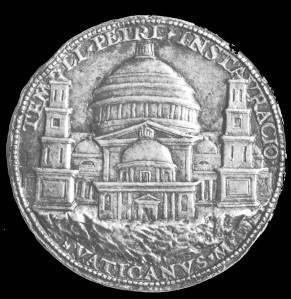
Present at the laying of the foundation stone were some of the major figures of the Renaissance; such as Cesare Borgia, Niccolò Machiavelli, and three future popes. The pit for the foundation stone was very deep and Julius II, at sixty-three years old, had to climb down into it. There was a fear that the ground might give way while the Pope was inside the pit and he warned others to not come too close. Inside the hole for the foundation stone – a block of marble “four palms wide, two broad, and three fingers thick” was placed an urn holding one dozen commemorative medals symbolizing the twelve apostles. Each medal had on one side an image of the pope and on the other a picture of the new church. The image on the medal was probably that of Bramante’s design – seen in the image accompanying this post.

The actual construction of St. Peter’s would take the next 120 years and several papacies, finally being completed on 18 November 1626. One method of financing the construction of the new basilica was through the selling of indulgences – this would later lead to the attacks of Martin Luther and the Protestant Reformation.

For more on St. Peter’s Basilica

Today in Catholic History – The Canterbury Tales

On 17 April 1397, Geoffrey Chaucer began his telling of the Canterbury Tales at the court of Richard II and, according to the text, it was on this date in 1387 that the pilgrims of the tale began their journey to the shrine of Thomas Beckett.

At the time in which the Tales were written, the Catholic Church was still suffering from the effects of the Great Schism – two and later three claimants asserted their legitimacy as pope at the same time.  Struggles to end the schism and return unity to the Catholic Church motivated calls for reform by such men as John Wycliffe – who attacked papal supremacy.

The Canterbury Tales thus reflect this difficult time in the Church.  Many of the characters are religious such as the Pardoner, the Summoner, the Friar, the Monk, the Prioress, the Priest and the Nun.   Chaucer uses these characters to attack what he considered the corruption among the clergy and to emphasize what he considered true religious virtue.  Chaucer wanted his stories to point out those who had failed to live as they should and also those who did serve as good examples to others.

Today, Chaucer’s work continues to serve as a model of the Christian pilgrimage to heaven, sinners and saints striving for holiness.  In his 2005 talk for World Youth Day, J. Francis Cardinal Stafford noted:

In this Catholic poet, we see how a many-layered tradition (pilgrimage to a shrine containing a relic) can eventually exhibit a whole range of phenomena, from the authentic spirituality of the Parson to crassest superstition and entrepreneurial greed. The very existence of such beliefs reveals the nature and quality of the Catholic faith at that time: Christians would not respond to a god as a mere abstract idea, an abstract spiritual principle or a subject of speculation. The Catholic faithful wished to see and touch the true God. This was no light matter.

The Canterbury Tales

Special Today in Catholic History – St. Francis takes his vows

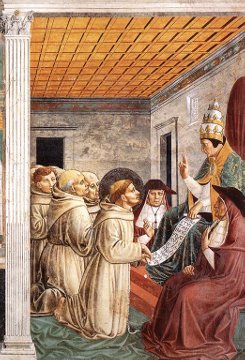
On April 16, Franciscans renew their vows in honor of St. Francis and his companions who made their vows into the hands of Pope Innocent III on this day in 1209.

According to the book Franciscans At Prayer, unfortunately out of print, the friars are to kneel in a circle around the altar after the celebration of Eucharist. They are to each carry a burning candle and pray for the help of the Holy Spirit. While they do this, the local minister is to encourage them to renew their profession and the Blessed Sacrament is exposed. In the name of all the friars, the local minister thanks God for the gift of being called to follow St. Francis, asks forgiveness for any sins against the Rule, repeats the vows of his solemn profession and then asks for the grace to persevere in the Rule until death.

This form as expressed in the Rituale Romano-Seraphicum in 1955 has been modified by various communities today but still contains these essential elements of renewal of vows, the importance of the Eucharist, and the emphasis on the community life. It should be noted that this renewal is intended as a devotional and has no juridical value. The renewal of vows is intended for Franciscans to recommit themselves to what they have already vowed to God that they would do.

Brothers, it has been a tradition in our Order that each year on April 16 – the day on which Francis made his profession into the hands of Pope Innocent III – we gather and renew our profession. The purpose of this renewal is to recall the origins of our Rule, to recall the devotion of Francis and his companions as they promised to follow the holy Gospel, to recall our own fervor as we begin this way of life, and to resolve to commit ourselves again to these ideals. Let us pray that with the help of God and the intercession of the Blessed Virgin Mary and St. Francis, we may regain our initial fervor and re-commit ourselves to the life we have professed – from Franciscans at Prayer

Today in Catholic History – Archbishop of New Orleans excommunicates three

On 16 April 1962 Archbishop Joseph Rummel of New Orleans excommunicated three Catholics for their public opposition to his plan to desegregate Archdiocesan schools.

New Orleans’ parishes and schools of the Archdiocese had been segregated since the failure of Reconstruction in the 1870s. Earlier Archbishops had sought to improve educational opportunities for black Catholics by establishing separate schools, but these schools were generally not as well funded or supported as the schools attended by white Catholics.

In 1948, Rummel admitted two black students to the Notre Dame Seminary. In 1951, he removed “white” and “colored” signs from the Catholic Churches and opened Saint Augustine High School – the first high school dedicated to the education of young black men. In 1953, he officially ordered the desegregation of the entire archdiocese. He wrote:

Ever mindful, therefore, of the basic truth that our Colored Catholic brethren share with us the same spiritual life and destiny, the same membership in the Mystical Body of Christ, the same dependence upon the Word of God, the participation in the Sacraments, especially the Most Holy Eucharist, the same need of moral and social encouragement, let there be no further discrimination or segregation in the pews, at the Communion rail, at the confessional and in parish meetings, just as there will be no segregation in the kingdom of heaven.

In 1956 he issued another pastoral letter proclaiming segregation incompatible with the teachings of the Catholic Church.

Desegregation faced a significant amount of opposition. One parish was ordered closed in 1955 when it refused to accept a black priest. Some Catholics sent a letter to Pope Pius XII seeking a papal decree in support of segregation, but Pius XII responded by declaring racism to be a major evil. Opposition to desegregation throughout Louisiana would delay school desegregation until the 1962-1963 school year.

In response to desegregation, there were public protests and threats to transfer children to segregated public schools. Archbishop Rummel threatened opponents with excommunication which caused most to accede to segregation but he would excommunicate three particularly vocal opponents for defying his authority. Again, opponents of desegregation sought support from the Vatican, but L’Osservatore Romano called Rummel’s actions “admirable”.

Eventually desegregation would be accepted throughout the archdiocese.

See Time Magazine articles on the subject
See article on one of the excommunicated
Today in Catholic History – Communium Interpretes Dolorum

On 15 April 1945, as WWII was coming to an and and on the same day the US army liberated the concentration camp at Colditz and the British and Canadian army liberated the concentration camp at Bergen-Belsen, Pope Pius XII issued his encyclical Communium Interpretes calling for the promotion of peace throughout the world.

In the encyclical, Pius XII reflected on the destruction caused by the war and called on the faithful to offer prayers to the Mother of God, especially in May – that month dedicated to her, that Christ might bring healing to all those who were suffering. In addition to the offering of prayers, the Pope called for a return to Christian morality and the renewal of public and private life. For, Pius XII warned that if true justice was not the goal then the world ran the risk of future wars.

The Pope specifically called for prayers for those who had been driven from their homes by the war and those who were imprisoned. Thus the encyclical served as an important document for the development of Catholic social teaching regarding the importance of peace and the care of refugees.

It is interesting to note that this was Pius XII’s first encyclical on the war, even though fighting had been raging throughout Europe ever since September 1 of 1939.

Communium Interpretes Dolorum