Category Archives: Today in Catholic History

Today in Catholic History – Beginning of the Fifth Lateran Council

On 3 May 1512, the Fifth Lateran Council opened under the authority of Pope Julius II with the participation of fifteen cardinals, two patriarchs, ten archbishops, fifty-six bishops, abbots, generals of religious orders and several ambassadors. Pope Julius would die while the council was in session and Pope Leo X would continue the council until its close on 16 March 1517.

Pope Julius had sworn an oath to call a council, but as he delayed to fulfill this vow some bishops organized their own council in Pisa with the support of French king Louis XII. Seeing this as a rival to his authority, Pope Julius denounced the council and called for his own council at the Lateran. While much of the initial motivation for the Fifth Lateran Council was to condemn the actions and decisions at the earlier council of Pisa, the Fifth Lateran also spoke of the need for reform within the Church – particularly on improving the quality of priests and prohibiting simony in the election of popes. But not much action was taken in this regard.

Fifth Lateran Council

Today in Catholic History – Pope Clement V and the Knights Templar

On 2 May 1312, Pope Clement V issued the bull Ad Providum which gave all the land and wealth which formerly belonged to the Knights Templar to the Knights of Malta so that it could continue to be used for the aid of pilgrims. Clement wanted to ensure that the wealth of the Templars did not fall into the hands of French king Philip IV who had been the driving force in the movement to suppress the Templars and very much desired their property. However, in many parts of Europe the property of the Templars was simply confiscated by the secular authority and not given to the Knight of Malta/Hospitallers.

It is generally believed that the primary reason for the attack against the Templars was the economic situation of Philip IV who owed the Knights Templar a large sum of money. Philip also need additional funds for his war against England. He therefore accused the Knights of heresy and pressured Clement V to dissolve the order on 22 March 1312 in the hopes of not only no longer having to pay back his loan but of also being able to confiscate Templar property.

Knights Templar

Today in Catholic History – Dedication of the Nea Ekklesia in Constantinople

On 1 May 880, Basil I dedicated the Nea Ekklesia. The Ottoman Empire would later use the church to store gun powder and the church would be destroyed when it was struck by lightning in 1490.

The Nea Ekklesia, or New Church, was designed to exemplify the construction projects of Basil and his wish to renew the Byzantine Empire. It was dedicated to Jesus, the archangel Michael, the Prophet Elijah, the Virgin Mary and Saint Nicholas. Basil had a special devotion to the Prophet Elijah because it was claimed that he appeared to Basil’s mother in a dream and encouraged her to sent her son to Constantinople where he would have a exceptional future.

The five domed church is believed to have been built in a cross-in-square structure and was the model of other churches throughout the Byzantine Empire. It was Basil’s Hagia Sophia and he designed it so that it could be seen from all over the city. It contained a spectacular mosaic of Christ Pantocrator, an iconostasis of gold and silver and a high altar of “a material more precious than gold”, as Photius described it. There was also a large mosaic of the Virgin Mary, “extending her pure hands towards us and granting to the Emperor long life and victory over his enemies.”

3-D reprodution of the Nea Ekklesia

Today in Catholic History – Priests for Life approved by Archbishop Quinn

On 30 April 1991, Priests for Life was approved as a Private Association of the Faithful by Archbishop John Quinn of San Francisco.

Priests for Life was founded by Fathers Lee Kaylor and Francis P. Filice to work for the promotion of life particularly through the end of abortion and euthanasia. It seeks to encourage and educate priests, bishops, and deacons in the promotion of life within their ministry. While the membership is primarily Catholic clergy, there are also lay auxiliary membership. Its present head is Father Frank Pavone.

In 2003, it received NGO status in the United Nations.

Priests for Life

Today In Catholic History – Joan of Arc arrives to lift the Siege of Orléans

On 29 April 1429, Joan of Arc arrived to begin lifting the siege of Orléans and turn the tide of the Hundred Years’ War.

France and England had been fighting for control of France off and on since 1337 and after the English victory at the Battle of Agincourt in 1415 the advantage in the struggle was definitely on the side of the forces of English regent John Plantagenet. The city of Orléans was the last fortress preventing access of the English forces into central France.

The English forces began the siege of Orléans on 12 October 1428 and so had surrounded the city for six months before Joan arrived in apparent fulfillment of the prophecies that an armed maid would deliver France.

Prior to her arrival, Joan sent the English forces besieging Orléans two letters demanding that the siege be lifted and that the English return to their homeland or else she would lift up a “…war cry against them that would last forever.”

When Joan arrived at Orléans she quickly began to pushing back the English forces, lifting the siege on 8 May 1429. This success would inspire many other French to join the army of the dauphin Charles. However, Joan would not live to see the end of the Hundred Years’ War. She would later be captured and killed by the English army on 30 May 1432. The last battle of the Hundred Years’ War would be fought in 1453.

More on the siege of Orleans

Today in Catholic History – Founding of University of Santo Tomas

On 28 April 1611, the University of Santo Tomas was founded in the Philippines by Archbishop of Manila, Msgr. Miguel de Benavides, O.P. It is one of the oldest universities in the world. It is also the largest Catholic university in the world.

Founded to prepare seminarians and called Colegio de Nuestra Señora del Santisimo Rosario, it was later named in honor of Saint Thomas Aquinas. It was raised to the rank of a university in 1645. In 1947, Pius XII made it “The Catholic University of the Philippines”.

The inspiration for the university began with the first Bishop of the Philippines, Bishop Domingo de Salazar, who wanted a college/university similar to those in Mexico. Bishop Benavides provided the first resources for the university when he bequeathed his library and property for the university’s foundation. Much of the effort promoting the early university was through the Dominican missionaries who came to the Philippines.

The university has had a very interesting history – visited by two popes, favored by the Spanish royalty, and serving as a prison camp during WWII.

History of University of Santo Tomas

Today in Catholic History – Battle of Mactan

On 27 April 1521, Spanish forces under the leadership of Ferdinand Magellan were defeated by the forces of Lapu-Lapu at Mactan Island. Ferdinand Magellan was killed.

Magellan had already achieved the conversion of the Philippino chieftain of Cebu to Catholicism and planned to bring Catholicism to the other peoples as well as placing the Philippines under the authority of the King of Spain. When Lapu-Lapu refused to recognize Magellan’s authority, Magellan decided to go to war against him.

Magellan’s numbers were around 49, those of Lapu-Lapu were more than 1,500 and in the battle Magellan was slain. His body was never recovered. The rest of Magellan’s crew would complete the first circumnavigation of the globe.

While Magellan is honored for bringing Catholicism to the Philipines, Lapu-Lapu is honored as a symbol against foreign occupation.

Battle of Mactan

Today in Catholic History – Clement XIV creates eleven cardinals in pectore

On 26 April 1773, Pope Clement XIV created as many as eleven cardinals in pectore or in the breast. None of the names of these cardinals was ever published. Though there is some speculation that Hyacinthe Cardinal Sigismond Gerdil, C.R.S.P. who would later be named a cardinal under Pope Pius VI was one of them.

The first Pope to appoint a cardinal in pectore was Pope Paul III. Other popes would follow this example throughout history. Pope John Paul II. A pope would chose to create a cardinal in pectore or secret if he believed that publicly naming the cardinal would threaten the cardinal’s life or the faithful in the country where the cardinal lived. For example, in the 20th century popes would create cardinals in Eastern Europe in pectore out of concern over a hostile communist response.

A cardinal created in pectore has no rights as a cardinal until his name has been publicly published and if the pope who named him cardinal dies before having declared their name their status as a cardinal comes to an end as well. However, when a cardinal created in pectore is named, his seniority in the College of Cardinals is dated from the time when he had been created in pectore, not from the time he was publicly named.

For more on in pectore cardinals

Today in Catholic History – The Second Diet of Speyer and the beginnings of Protestantism

On 25 April 1529, Lutheran representatives at the Second Diet of Speyer issued a letter of protest against the decisions of the Diet’s Roman Catholic majority to enforce the Edict of Worms and prohibit further reformation in the Holy Roman Empire.

The purpose of the Second Diet of Speyer, which began on 15 March 1529, was to coordinate the response of the German princes and other leaders of the Holy Roman Empire against the threat of the Turks and address the issue of division in the Empire brought about by the ideas of Martin Luther and Heinrich Zwingli.

Attendees of the Diet who supported the Catholic Church wanted to reverse the earlier policy of religious tolerance adopted in 1526 at the First Diet of Speyer. This Diet had permitted “each one to live, govern and carry himself as he hopes to answer it to God and His Imperial Majesty.” Reversing the decisions of the First Diet was also the desire of Archduke Ferdinand, who led the Diet in the name of his brother the Holy Roman Emperor Charles V. Ferdinand ordered that all of the states of the Holy Roman Empire were to tolerate the practice of Catholicism, but Lutheranism would only be tolerated in those German states which had already done so – not in any additional states. Any further attempt to institute Lutheranism would be prohibited. Followers of Zwingli and the Anabaptists would not be tolerated at all. Indeed Anabaptists were to be put to death.

In response, the Lutheran attendees of the Diet issued a legal appeal on behalf of themselves, their subjects and all Christians. This appeal was a protest against those decisions of the Second Diet which they deemed contrary to the Word of God, their consciences and the earlier decisions of the First Diet of Speyer. It was signed by six German princes and representatives of fourteen Imperial Free Cities.

This protest would result in the term “Protestant” to be applied first of all to Lutherans and then to all non-Catholic and non-Orthodox Christians.

More on the Second Diet of Speyer

Today in Catholic History – The Armenian Genocide

On 24 April 1915, 250 Armenian intellectuals and community leaders were arrested in Constantinople/Istanbul marking the beginning of the Armenian genocide that would eventually take the lives of one and a half million people. Another one half million would flee Turkey.

The Young Turk government that replaced the Ottoman Empire at the end of WWI sought to eliminate any non-Turkish elements of the population. The large Armenian population – which at that time numbered around two million was a major obstacle to the goals of the new government.

While the brunt of the genocide fell upon the Armenian Apostolic Church, the Armenian Catholics would see 19 eparchies, 156 churches and chapels, 110 missions, 148 schools, 32 monasteries and convents and six seminaries destroyed. 7 bishops, 130 priests and 47 nuns and as many as 100,000 Armenian Catholics died, including Blessed Ignatius Maloyan. Most Armenian Catholics would flee Turkey for Lebanon and Syria. The Armenian Catholic Patriarchate would be transferred to Bzoummar, Lebanon.

The Martyrdom of Blessed Bishop Ignatius Maloyan:

On June 3, 1915, Turkish soldiers dragged Bishop Maloyan in chains to court with twenty seven other Armenian Catholic personalities. The next day, twenty five priests and eight hundred and sixty two believers were held in chains. During trial, the chief of the police, Mamdooh Bek, asked the Bishop to convert to Islam. The bishop answered that he would never betray Christ and His Church. The good shepherd told him that he was ready to suffer all kinds of ill-treatments and even death and in this will be his happiness.

Mamdooh Bek hit him on the head with the rear of his pistol and ordered to put him in jail. The soldiers chained his feet and hands, threw him on the ground and hit him mercilessly. With each blow, the Bishop was heard saying “Oh Lord, have mercy on me, oh Lord, give me strength”, and asked the priests present for absolution. With that, the soldiers went back to hitting him and they extracted his toe nails.

On June 9, his mother visited him and cried for his state. But the valiant Bishop encouraged her. On the next day, the soldiers gathered four hundred and forty seven Armenians. The soldiers along with the convoys took the desert route.

The bishop encouraged his parishioners to remain firm in their faith. Then all knelt with him. He prayed to God that they accept martyrdom with patience and courage. The priests granted the believers absolution. The Bishop took out a piece of bread, blessed it, recited the words of the Eucharist and gave it to his priests to distribute among the people.

One of the soldiers, an eye witness, recounted this scene: “That hour, I saw a cloud covering the prisoners and from all emitted a perfumed scent. There was a look of joy and serenity on their faces”. As they were all going to die out of love for Jesus. After a two-hour walk, hungry, naked and chained, the soldiers attacked the prisoners and killed them before the Bishop’s eyes. After the massacre of the two convoys came the turn of Bishop Maloyan.

Mamdooh Bek then asked Maloyan again to convert to Islam. The soldier of Christ answered: “I’ve told you I shall live and die for the sake of my faith and religion. I take pride in the Cross of my God and Lord”. Mamdooh got very angry, he drew his pistol and shot Maloyan. Before he breathed his last breath he cried out loud: “My God, have mercy on me; into your hands I commend my spirit”.

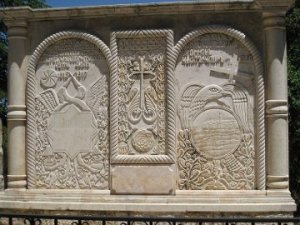
Photo of the Memorial to the Armenian Genocide at the Armenian Catholic Patriarchate by Serouj
Armenian Genocide Museum
Armenian Catholic Church