Category Archives: Today in Catholic History

Today in Catholic History – Pius IX approves the Red Scapular

On 25 June, Pius IX approved the Red Scapular of the Passion of Our Lord and the Sacred Hearts of Jesus and Mary for use as a sacramental.

The scapular is made of red wool with one side bearing the image of the crucifix, instruments of the Passion and the words “Holy Passion of Our Lord Jesus Christ Save Us.” The other side bears an image of a small cross above the Sacred Heart Jesus and the Immaculate Heart of Mary and the words “Sacred Hearts of Jesus and Mary, protect us.”

Sister Appoline Andriveau of the Sisters of Charity claimed that the devotion of the Red Scapular was revealed to her during a series of visions of Jesus and Mary in 1846. Sister Appoline said that she was promissed that those who wear the scapular faithfully and contemplated the Passion of Jesus Christ would grow in faith, hope, and charity.

Pope Pius IX, in approving the use of the Red Scapular, also granted with it various indulgences. Originally the Lazarist Order was responsible for blessing and investing someone with the Red Scapular, but now any priest can do so.

For more on scapulars and the Red Scapular

Today in Catholic History – Pope Clement VII confirms the Order of the Theatines

On 24 June 1524, Pope Clement VII approved the establishment of the Theatine Order in his Brief Exponi Nobis.

The Theatines were founded by Saint Cajetan, Paolo Consiglieri, Bonifacio da Colle, and Giovanni Pietro Carafa and named after the Italian city Chieti/Theate where Carafa was Bishop. The order was consecrated to the Cross and Saint Cajetan and the other Theatines will make their profession before the pope on September 14th – the Feast of the Holy Cross.

The main charism of the Theatines was to encourage both clergy and laity in the practice of virtue. One of the reasons for the establishment of the Theatines was in response to the attacks of Martin Luther and the Protestant Reformation.

The Theatines accomplished much good work with their oratories and missions and include in their number one pope – Paul IV. However, the mid-late 19th century suppression of religious orders struck the Theatines particularly harshly. The Theatines vow of poverty prohibited them from owning any property and so was left with very little when their order was disolved many parts of Europe.

There are also Theatine Sisters and it was through Venerable Ursula Benincasa, who founded the Order of Theatine Nuns, that the devotion of the Blue Scapular of the Immaculate Conception was established.

Today in Catholic History – Bishop Karol Wotyła ordains Stanisław Dziwisz

On 23 June 1963, Stanisław Dziwisz was ordained to the priesthood for the Archdiocese of Krakow by Bishop Karol Wojtyła.

He will serve briefly as a parish priest before becoming the personal secretary of Wojtyła in October 1966 – a position he will hold until the death of Pope John Paul II in 2005. On 3 June 2005, Dziwisz will become the Archbishop of Krakow and a cardinal on the 24 March 2006.

George Weigel will describe the relationship between Pope John Paul II and Cardinal Dziwisz as “that which every father wants from a son: love and duty without fear or synchophany. Dziwisz brought complete loyalty, utter discretion, sharp judgement, a puckish sense of humor, and indefatigability to the job.”

More on Cardinal Stanisław Dziwisz

Today in Catholic History – Condemnation of Galileo

On 22 June 1633, Galileo was condemned by the Roman Inquisition.

In 1616, the Roman Inquisition had acted against Galileo for these reasons : holding the doctrine that the sun is at the center of the universe and immovable and that the earth moves; teaching and writing about this belief to others; for publishing a book presenting this doctrine and for expressing a doctrine which was contrary to the true sense and authority of Holy Scripture.

He was ordered to abandon this doctrine and to no longer teach it. All books which presented this doctrine were to be prohibited. Galileo agreed with the Inquisition’s decisions and did not discuss these ideas for sixteen years.

But in 1632, he published a book, “Dialogue of Galileo Galilei on the Great World System,” which the Inquisition deemed violated Galileo’s earlier promise. Therefore, the Inquisition ordered that Galileo was to formally reject the doctrine that the sun was immovable and the center of the universe and that the earth moved, the offending book was to be prohibited, he was placed under house imprisonment, and each week for three years was to repeat the seven penitential Psalms.

On 31 October 1992, Pope John Paul II apologized for the condemnation of Galileo.

The text of the condemnation of Galileo

Today in Catholic History – Charles I Answers the Nineteen Propositions

On 21 June 1642, Charles I presented his response to the Nineteen Propositions which had been submitted to him by the English Parliament. While the Propositions are mostly known for their demands for limitations upon the power of the King, they also contain demands regarding the treatment of Catholics in England.

The Propositions demanded that the present laws against Jesuits, Catholic priests, and those who refused to attend Anglican services. They also demanded that the votes of Catholics in the House of Lords be removed and that the children of Catholic receive a Protestant education. Moreover they demanded that King Charles I formalize an alliance with the Dutch “in order to defend them from the Pope and his followers”.

While Charles I, in his Answer to the Nineteen Propositions, will reject those proposals which he believed illegitimately limited his power, he will not reject those propositions directed against Catholics. Indeed he will support them and offer to strengthen their enforcement.

The conflict between Charles I and the English Parliament as demonstrated in the Nineteen Propositions and Charles I’s response will eventually lead to the English Civil War.

The Nineteen Propositions and Charles I’ Answer to the Nineteen Propositions

Today in Catholic History – Synod of Diamper

On 20 June 1599, the Synod of Diamper began in Udayamperoor/Diamper in Kerala, India] under the leadership of Archbishop Aleixi de Menezes.*

When the Portuguese encountered the Thomas Christians after the arrival of explorer Vasco de Gama in 1498, the Thomas Christians were part of the Assyrian Church of the East or Chaldean Church.* As a result of Portuguese missionary activity many Thomas Christians were influenced by the rituals and practices of the Roman Catholic Church and in 1552 a group of Thomas Christians entered into communion with the Pope.

However, the Portuguese hierarchy in India wanted to bring the Thomas Christians into closer jurisdiction of the Latin hierarchy and replace the Assyrian/Chaldean liturgy with that of the Roman Catholic Church. Many of the local customs were condemned as heretical and many of the liturgical books of the Thomas Christians were ordered corrected or were burnt.

The Archbishop summoned all priests to the Synod of Diamper under pain of excommunication. 130 priests and 660 laymen met at the Synod which lasted until 26 June 1599. The Synod, presided by the Archbishop of Goa, condemned the Chaldean Patriarch who was in communion with Rome to be a heretic and a schismatic, Thomas Christians were not to accept any bishop except one immediately chosen by Rome, and the Latinization/adoption of Roman Catholic traditions and practices was confirmed.

More recently, the studies of Bishop Jonas Thaliath has demonstrated that the Synod of Diamper was invalid on the grounds that the Synod was convoked without the proper authority from Rome and did not follow Canon Law.

The effect of the Synod was to provide a greater push toward the further Latinization of the Thomas Christians and to separate them from their historic ties to the Chaldean Church. As the Catholic Encyclopedia notes, “The only case in which an ancient Eastern rite has been willfully romanized is that of the Uniat Malabar Christians, where it was not Roman authority but the misguided zeal of Alexius de Menezes, Archbishop of Goa, and his Portuguese advisers at the Synod of Diamper (1599) which spoiled the old Malabar Rite.”

Moreover, hostility from the Thomas Christians to the Portuguese treatment led to the Koonan Kurishu Satyam (Koonan Cross Oath) in 1653. At which some of the Thomas Christians swore that they would not obey the Portuguese bishops or the Jesuit missionaries. This will lead to a split among the Thomas Christians between the Syro Malabar Catholic Church which followed the Synod of Diamper and the Syriac Orthodox which did not.

The history of the Syro-Malabar Church

*The native Christians of India called themselves Thomas Christians because there tradition states that they were evangelized by Thomas the Apostle.

Today in Catholic History – The Nicene Creed

On 19 June 325, the delegates at the Council of Nicea agreed to a statement of belief which has come to be known as the Nicene Creed. This statement expresses the core doctrine and dogmas of the Catholic, Lutheran, Anglican, and the Eastern and Oriental Orthodox churches. One tradition states that the Nicene Creed was originally formulated by Saint Athanasius.

One of the primary reasons for the Nicene Creed was to deal with the Arian heresy which denied that Son was truly divine as the Father is divine. Therefore, the Nicene Creed includes phrases which emphasis an equality between the Son and the Father – “begotten not made”, “true God from true God”, “light from light”, “one in being with the Father”.

The Nicene Creed is different the from the modified Nicene-Constantinopolitan Creed recited every Sunday and solemnity in the Roman Catholic Church. For example, the Nicene Creed expresses the words “I believe in the Holy Spirit”, whereas the Constantinopolitan Creed adds the words “who proceeds from the Father, who together with the Father and the Son is worshiped and glorified, who spoke through the prophets.” Later the Roman Catholic Church also added the filioque or the words “and the Son” to the Constantinopolitan Creed i.e. “who proceeds from the Father and the Son, who together with the Father….”*

For more on the Nicene Creed and how it compares with the Nicene-Constantinopolitan Creed

*While this addition has caused a great deal of controversy between the Orthodox and Catholic Churches, interestingly enough it was originally added to deal with the Arian heresy in Spain – stressing that the Spirit proceeded from the Son as the Spirit proceeded from the Father was a way of emphasizing that the Son was equal in divinity to the Father.

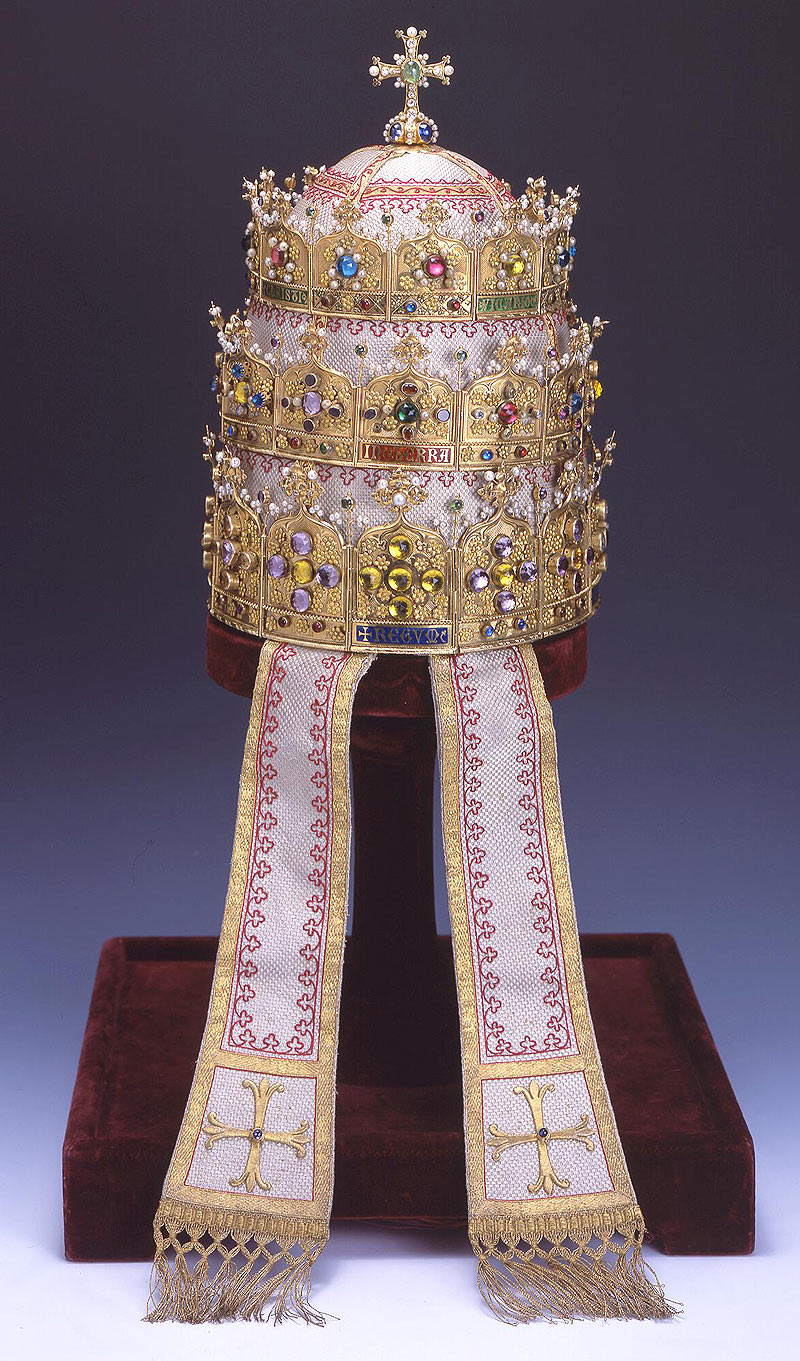
Today in Catholic History – Pius IX receives the Belgian Tiara

On 18 June 1871, the Ladies of the Royal Court of the King of the Belgians gave one of the most unique of Papal tiaras to Pius IX. The tiara was given in honor of the 25th anniversary of his pontificate. There is also some speculation that the tiara was given in response to the recent loss of Rome to the Kingdom of Italy.

The tiara, designed by Jean-Baptiste Bethune of Ghent is unusual not only in its conical shape but also because it contains the words CHRISTI VICARIO — IN TERRA — REGUM spread over its three crowns. It is made of gold, pearls, gilt silver, emeralds, enamel, agates and rubies. It is not known if the tiara was ever worn and no papal tiara has been worn since June 1963 when Pope Paul VI ceased to wear one.

Image of the Belgian Tiara

Today in Catholic History – Catholics obtain religious freedom in Hawaii

On 17 June 1839, King Kamehameha III issued an Edict of Toleration permitting Catholics in Hawaii to freely practice their religion which had been facing severe persecution.

Under the influence of Congregationalists from New England, Kamehameha III’s mother had been baptized and the Congregationalists encouraged a policy preventing the establishment of a Catholic presence in Hawaii. Catholic priests were forcibly expelled from the country on 24 December 1831. Native Hawaiian Catholics accused King Kamehameha and his government of imprisoning, beating and torturing them.

On 10 July 1839 a French frigate sailed into Honolulu Harbor on the justification that it was sent to protect the rights of the Catholic Church. Its captain had been ordered to:

Destroy the malevolent impression which you find established to the detriment of the French name; to rectify the erroneous opinion which has been created as to the power of France; and to make it well understood that it would be to the advantage of the chiefs of those islands of the Ocean to conduct themselves in such a manner as not to incur the wrath of France. You will exact, if necessary with all the force that is yours to use, complete reparation for the wrongs which have been committed, and you will not quit those places until you have left in all minds a solid and lasting impression.

King Kamehameha feared a French attack on his kingdom and so issued the Edict of Toleration permitting religious freedom for Catholics in the same way as it had been granted to the Protestants. King Kamehameha also donated land on which the first permanent Catholic church would be constructed, the Cathedral of Our Lady of Peace, and paid $20,000 in compensation to the Catholics who had been persecuted.

More on the Edict of Toleration in Hawaii

Today in Catholic History – Pius IX elected to the papacy

On 16 June 1846, Giovanni Maria Mastai-Ferreti, the Archbishop of Imola, was elected to the papacy on the fourth ballot. Upon his election he took the name of Pius IX.

Austrian Emperor Ferdinand had sent the Cardinal Karl Kajetan Gaisruck, the Archbishop of Milan [which at that time was part of the Austrian Empire] to veto the election of Ferretti because he was perceived to be too liberal.* However, by the time Gaisruck arrived at the conclave, Ferretti had already been publicly proclaimed to be the new pope.

Pius IX was crowned as pope on 21 June 1846 and would be the longest reigning pope since St. Peter. He served as pope for almost 32 years.

Although he had been chosen for the papacy with the reputation for liberalism, after the Revolutions of 1848 and his forced flight from Rome Pius IX would become a strong supporter of conservatism.

More on the Conclave of 1846

*There were several times at which a European ruler would try to veto the election of a particular candidate which they did not favor. While the cardinals at a papal conclave never officially recognized the rite of a secular ruler to veto a particular papal election, usually a vetoed candidate would not be chosen by the conclave. See Jus exlusivae